
Nominated for Best Animated Short Film at the 2026 Oscars.
What’s the first thing you’ll do when you retire? Will you jump straight into daredevilry like paragliding and psychedelics, or would you sit around deleting your spam emails and catching up on all the links you bookmarked for later? John Kelly’s darkly comic short Retirement Plan asks such questions while tapping into relatable fears of missing out and facing mortality. Nominated for this year’s Oscar for Best Animated Short Film, the Irish director breaks down his journey to the Oscars, roping in Domhnall Gleeson as the narrator, and revealing his own bucket list.
Where did you get the inspiration for a film about a middle-aged man’s post-retirement desires? Did your own bucket list act as an inspiration?
I’m easily overwhelmed and continually make lists to try to get on top of things. The idea of a man's ultimate to-do list being thwarted by his own mortality immediately felt like an appealing setup. I definitely share a few of his goals. At 45 years old, I’m still searching for my sport.
The short is animated with a minimalist 2D aesthetic. Can you break down the animation style, and why did you choose to visualise it as such?
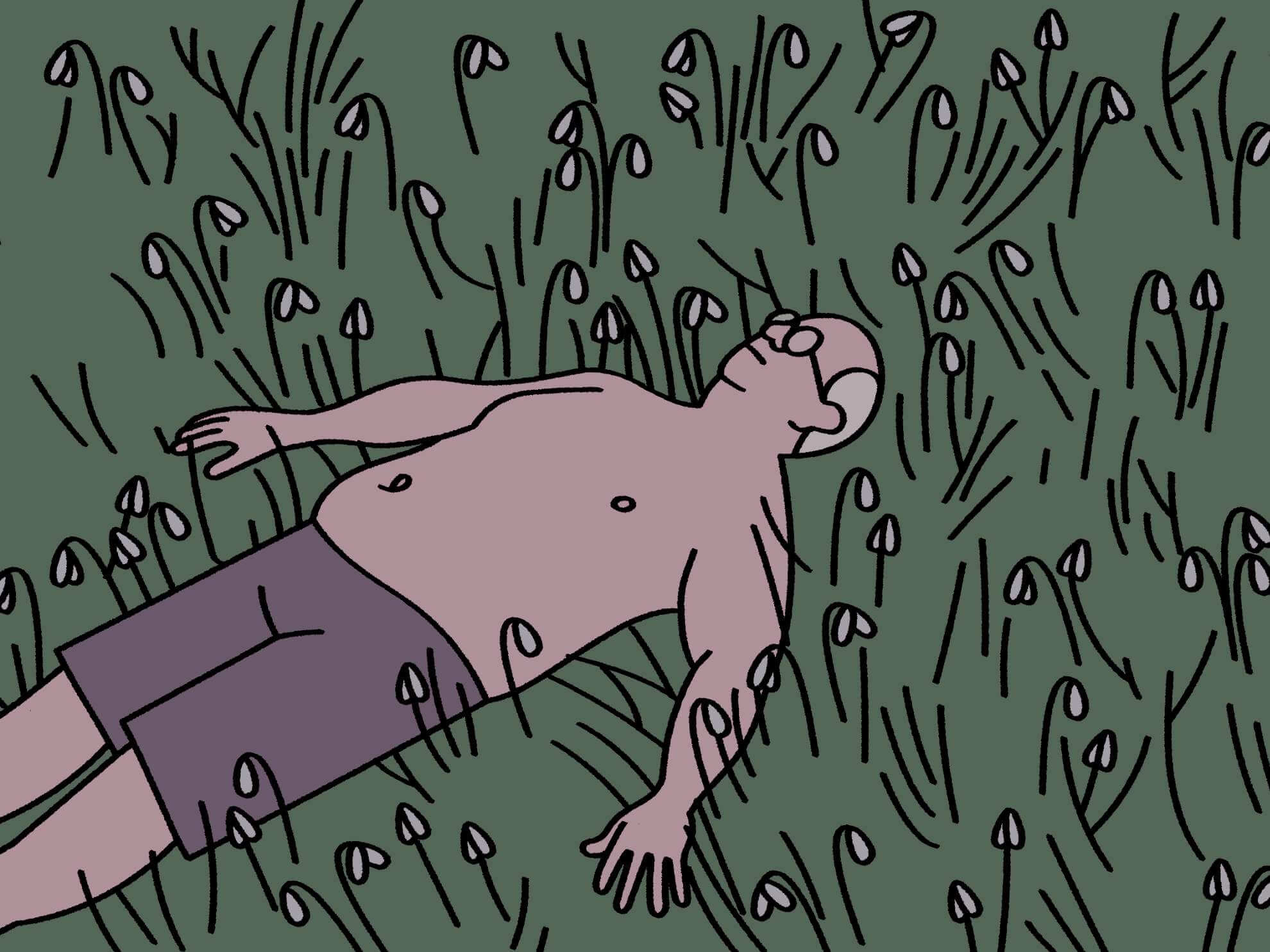
Long before working in animation, I started out drawing comics and then worked for years as a graphic designer. On reflection, this film is probably a combination of both of these sensibilities. Graphic design taught me that you can do more with less, and sometimes a simpler approach with no frills can be as effective (if not more effective) than something elaborate. This stripped-back method was balanced in other ways - for example, having over 100 shots in 7 minutes.
You have previously shared on YouTube about how you doubled as a “stand-in” to animate most movements of your lead character, Ray. What was that experience like?
I had been struggling a little to articulate my brief for the animators. So I decided — and this is quite common — to record reference. Footage in which I put my phone on a tripod and acted out every scene in the film in my messy kitchen and garden. What’s perhaps less common is that this film portrays quiet moments of reflection; the process helped me calculate what felt like the least amount of movement possible. There are scenes later on with bigger movement, and cutting the entire film together in this way allowed me to find the balance and contrast of the entire overall edit before animation began.
How did Domhnall Gleeson get on board as the narrator of Retirement? What was it like working with a seasoned character actor like him?
I cold-emailed Domhnall’s agent with a personalised video presentation I’d made for him. He’s very funny and sharp in person, and immediately just got the sensibility. Like my co-writer Tara Lawall, Domhnall is tirelessly keen to make it as good as it can be, at every stage of production. As an experienced filmmaker himself, he was able to offer a fresh perspective on the film, but was very tactful with any suggestions.
Did any pre-existing films, novels, or other artworks influence the themes and visuals of Retirement Plan?
Yes, I’m a big fan of documentary films; things like American Movie, the Maysles brothers, more recently Lance Oppenheim and John Wilson. I grew up reading The Far Side and Calvin and Hobbes early on, both of which marry silly humour with unexpected profundity. Graphic novelist Chris Ware’s ability to imbue humour and melancholy into postage-stamp-sized frames has always been hugely inspiring.
How long was the journey from conceptualising the short, animating it, distributing it for awards, until the Oscar nomination?
The overall journey from idea to Oscar nomination was around three and a half years. The film production itself was 9 months. It was the most enjoyable experience I’ve had making anything, in large part due to how much free rein I had. Ordinarily, I’m used to many stakeholders requiring rounds of approval, particularly on commissioned work. I remember a particular highlight: sitting alone in my home office, in front of the edit, saying to myself, “The edit is locked.” Pure liberation.
What was your first reaction when you found out your film was in the running for an Oscar?
Our first reaction was shock - we hoped, but didn’t expect this. Then another wave of shock hit as I realised a few shortlisted films that felt like shoo-ins hadn’t made it through to the nomination phase (they say animated short is one of the most unpredictable categories, and I can well believe it). Then, within seconds, I was being interviewed on Irish national radio. This was soon followed by the biggest deluge of messages I’ve ever received, on every conceivable platform. I’m still catching up.
What’s next after awards season for you? Any plans for another short or maybe a feature?
I’m currently making a short, non-fiction animation about one time ten years ago when I woke up with a giant rat on my chest at 5 in the morning. My wife and I then spent the two most intense hours of our lives trying to chase it out of the bedroom. It will be a bit of a pace change from Retirement Plan.
For a filmmaker behind a darkly comic short about retirement plans, what does your retirement plan look like in the future?
I can’t see myself retiring. I’m fortunate to be vocationally in love with filmmaking and animation, so even if I could afford to one day, I think I’d want to continue creating anxiety-inducing short films.
Retirement Plan is streaming on Disney+ (UK).
Watch The 2026 Oscars March 15, 2026 on ABC and Hulu (7 p.m. ET/4 p.m. PT).