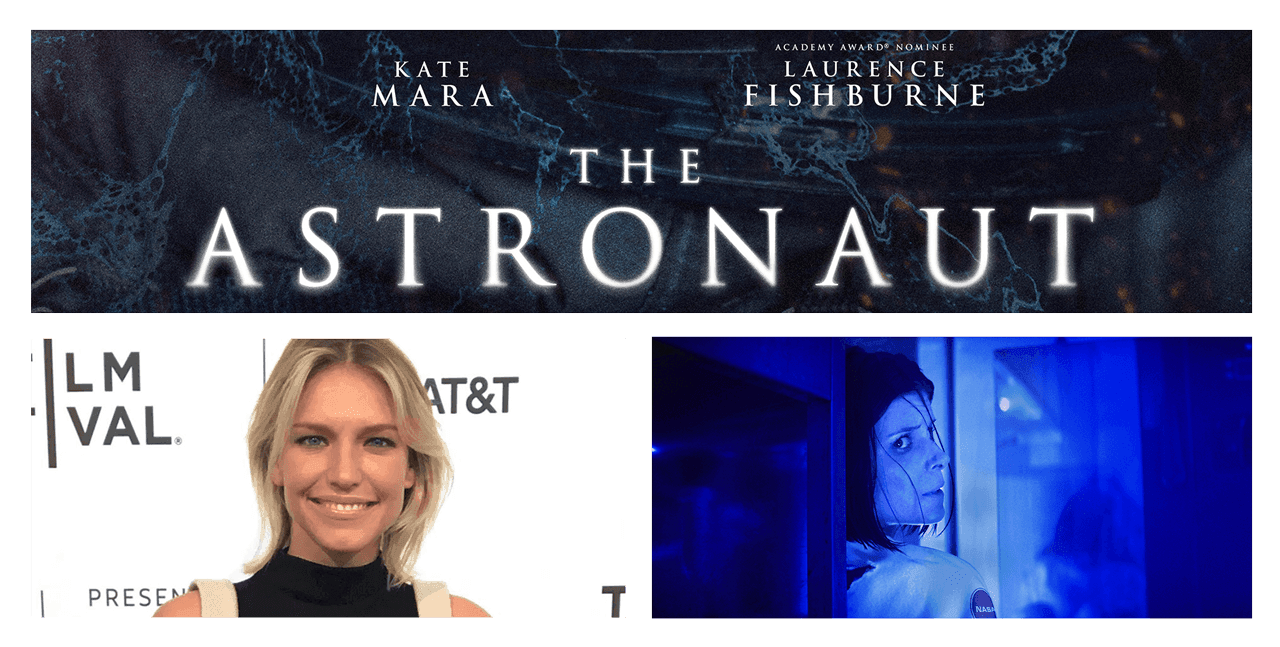
With the Artemis II crew’s historic return to Earth this week making headlines, there is no better time to look at The Astronaut: a space traveler gets existential in Jess Varley's sci-fi drama. In this interview, the writer and director talks about consulting real-life astronauts, her love for Spielbergian space films, and scouting for an "Ex Machina" house.
Not available in your country? Access worldwide streaming catalogs securely with NordVPN.
Listen here. The following transcript has been edited and condensed for clarity:
Hello everyone, I am Shaurya Thapa of Borrowing Tape, and greetings to our listeners on planet Earth. I say that because today I'm joined with Jess Varley, the writer and director of the space drama The Astronaut. Welcome Jess. How are you feeling today?
I'm great. Thank you so much for having me. How are you?
I'm good. I'm on planet Earth. No motion sickness. I could never be one, but that's great to hear, Jess.
Before I get into the details, your film features Kate Mara as an astronaut who crash-lands back to Earth and is then put under a very strict, very mysterious quarantine. My first question to you is, how did your fascination with space and space travel begin? Did you ever want to be an astronaut yourself, like many people in their childhood?
[Laughs] Totally. Well, it's so funny because as a kid, I remember seeing all those commercials for Space Camp, and I was like, "This is the coolest thing ever.” I did not go to Space Camp, so I think I'm just fulfilling that that wish as an adult now. It's so funny because I grew up in Brooklyn and my dad and I used to climb up his fire escape on his building with this little telescope, and we would put a blanket out and we would try to stargaze in Brooklyn, which is difficult to do because there's quite a lot of light pollution. He always had a fascination for it and I'd love when we would go camping and you could really see the stars and and just really ponder what's out there. It's obviously a pretty human fascination, but in terms of going to space, I used to want to do it as a kid. But honestly, I think I'd be way too scared now. I'm happy to keep my feet on the ground.
Your film itself builds that tension, because while I was watching it, that was my thought as well, that this is the reason why I would not be interested in space travel; there's so much testing and training to be done.
Even in your film, Kate Mara's character, Sam, faces these hallucinations when she's back from space. For example, things are floating around her like she's in zero gravity, even though she's just hallucinating. What kind of research went into capturing this post-space trauma for your heroine?
Well, I had the great fortune of interviewing Dr. Elizabeth Warren, who's basically head of the NASA rehab program. She oversees all of the rehabilitation for the astronauts when they come back from space. She was just the nicest person and had so much incredible insight to share that tons of it was infused into the script. She told me about all of these fascinating things that they deal with that you would never know. I also got to interview a real astronaut, which was so cool. So much of what they told me is in the script. Everything from astronauts really hiding their symptoms is actually a real thing that they do because it is true that if they're deemed too sensitive for space travel, they often will not be allowed to fly again. Everything from that all the way through the symptoms, all the way through Kate's character, Sam requesting a cheeseburger when she returns is all something that astronauts... like everyone wants a cheeseburger when they come home, because I think the dehydrated space food leaves much to be desired. And the fact that it's really hard on families. I think that is obviously something that's in there, but it's like being a military family or a military spouse: your partner goes out on this really dangerous mission for months at a time, and you don't really know if they're gonna make it home or not. That reality is also something that I tried to infuse into the story.
You mentioned all the facts, now coming to the fiction: were there any space or non-space films that inspired The Astronaut?
Definitely. Okay, I obviously love Arrival. Who doesn't love Arrival? Absolutely stunning. Then, obviously, there's the nostalgic ones: E.T. and Close Encounters. Ridley Scott, who is also incredible. Yeah, there's definitely a lot of influences in there. That's why I feel like the film is colorful, and in terms of its range and scope, it isn't just one tone or one thing the whole way through. I tried to let it breathe and allow it to be something unexpected, and challenge the genre a little bit, so that it didn't get too much like, well, it's a horror movie all the way through, and in the end, she gets torn apart by the aliens, and she dies, and then the movie's over. There was this longing for the beauty that movies like Arrival, Close Encounters, and E.T. tap into, where there's a real sweet connection to space and the aliens don't have malicious intentions.
Yeah. What struck to me, like you just mentioned E.T. and Close Encounters, talking about Steven Spielberg, there is a scene. I'm not giving any spoilers for our listeners, but there's a scene where Sam is hiding from a certain threat, and the way she's hidden, stealthily, it reminded me of that classic Jurassic Park scene where these kids are hiding from the raptors in the kitchen. Was that like an intentional homage? Or did you notice it after filming that? Oh, this reminds me of Jurassic Park.
Totally. It's funny because it was a bit of both. I think we always imagined it to be this Jurassic Park-style scene. There was the happenstance that the location we were filming at had that industrial kitchen, which was so reminiscent of the film, because we didn't have the resources to build a replica kitchen. The fact that it happened to be actually like the Jurassic Park kitchen, to me, was so fun, and I was happy to lean into it, even down to post [production] when we were really fine-tuning the way the aliens moved in the space; we were totally trying to lean into that dinosaur, that heaviness, and that gravitas that they have. It was always there, but then, by a series of just fortunate events, we just leaned into it. It's hard because I think people put that movie obviously on such a high pedestal because everyone feels so connected to it in such a personal way from childhood. It's a little bit of an old taboo, I feel like, to reference it. It's not like Tarantino, where people are like, " Oh, that's really cool. It's an homage.” People are like, " How dare you, Jurassic Park!” Which I totally get, I totally get, but it was so fun. I think it just brought out the kid in me. Even moments like when she looks over her shoulder. There are moments that really take me into those movies. But there was never like.. I didn't ‘take any shots’ or anything like that. It was just like the energy felt so much like the movie that it just became what it was.
And you just mentioned the setting of your film, and the location where you were shooting. Most of the film takes place not in space, but in a desolate and, dare I say, very swanky house. I love how minimalist and stylish that house was. This is the house where Sam, the heroine, is quarantined and tested. What were some of the behind-the-scenes challenges for you while filming in such a single, limited setting?
Our script supervisor said it was one of the most complicated continuity films because, for the most part, it's very linear, and it happens in real time for a lot of the movie. There's the progression of what's going on with her body as that's happening. Honestly, the location ended up being a massive gift, because when we were scouting, we explored every option from building on a stage, which was too expensive, to finding a house that we liked that was by the ocean, and the setting didn't work, and we were going to have to try to find a forest, and then, we were going to have to try to stitch them together; that's difficult when you're moving between spaces and looking out of windows. We were very lucky with that location. Obviously, we painted the house. We totally dressed it. We did all of these things to give it this total makeover and make it our Ex Machina house; it was so fortuitous. The fact that you can really see this beautiful autumn forest through the windows of the house and really feel that isolation in an in-camera real way was actually a huge gift. Even our subterranean level in the movie was at a kids' science center that was like 10 minutes away, where our base camp was. We ended up just using that space, playing around with it, and repurposing elements there. We really lucked out. We did a lot of scouting to get there, but it really was very, very fortuitous.
Where exactly was this location that you're talking about?
It was in this area called Wicklow, about 40 minutes outside Dublin. It's really fun. I got to live in Ireland for three months, which was so cool.
Yeah, that's pretty interesting. Now I know next, where, if anyone from outer space visits Ireland, it would be on the travel list.
If you're game for Guinness.
As you just mentioned, the so-called Ex Machina house, and Ex Machina itself, when I watched it, compared to when I watched it after COVID, it turned out to be unexpectedly a very COVID film; these three people are doing the research and collectively losing their minds. Even in The Astronaut, we see Sam being quarantined, being tested, and being driven to her mental limits. Were there any, like, COVID influences on the story then? Or did you feel like that would be a bit too cliche if not done right?
The movie originally was written at the height of COVID. I pitched the concept to Brad Fuller, our lead producer, in January 2021. Even at that time, we're very much in our little COVID bubbles of who we were spending time with or not, it was still very much that era. Even having dinner with him to talk about it was a huge leap to be like, okay, we're gonna leave the bubble, and we're going to go to his house. Even that was sort of risky at the time. The movie was originally written to be super micro-budget, one-location, and COVID-friendly. Kate's character, Sam, was the only person in the movie not in a hazmat suit. Everyone who was visiting in her family, was gonna be wearing hazmat suits, and thank God we changed that because, oh boy, the one scene that we have in the movie with people in hazmat suits, it was a nightmare. That was the hardest thing to film. Yes. They fog up. They're hard for sound. People get claustrophobic in them. It would have been just awful for people to have to watch a movie wherever it was in a hazmat suit the entire time. There were certain things that, as the COVID era lifted through the long process of developing the movie, we were able to expand the world and pull back on some of those very COVID-heavy influences as we came out of it.
I'm glad you didn't stick with the hazmat suits because there's so much of a family element in this as well, like there's the military family angle that you mentioned. For me, some of the scenes that worked were Gabriel Luna, who plays Kate Mara's husband and their daughter, and them showing up for her. If they showed up in hazmat suits, are they really her family? I don't know. I can't even see beyond the mask.
A little girl in a tiny hazmat suit.
You get to work with quite some versatile character actors. You obviously have Kate Mara, Lawrence Fishburne, and Gabriel Luna. You are also an actor; you have been acting for quite some time in TV shows and films. How does your acting background help you with directing actors in your own film?
It's honestly so tremendously helpful. I've worked on crews with directors who have zero acting background, and they're only really good at visual effects, or they're only thinking about the cinematography and things like that, but performance is so important. Having that shorthand with the actors. These actors are far beyond any level I could have ever dreamed to be, and they're just so highly skilled. If anything, it's a lot of trying to get out of the way and not overcomplicate things because they're so talented and just letting them do their thing. Just having that shorthand and that understanding of how to just really push it too. Kate really, really, really goes there and allows herself to be really messy and become super undone from this very sophisticated, put-together professional astronaut that you meet in the beginning, and just leaning into the performance of that, and the progression of her body transformation, and just all of that experience that I had in the past, it helped give me the language and the tools to be able to try to support these incredible actors as they moved through the whole range that's in the script.
Coming to your directing work, you are no stranger to the horror genre, because previously you directed segments of the anthology film Phobias, and how different was filming The Astronaut from your past horror work? Because in this film, it's your entire story, it's not even an anthology. Having that free rein?
Phobias was great because it ended up being film school for me, because I went to acting school, but I did not go to film school. Part of my working on movie crews for years, production, coordinating, and doing all that was super helpful. Doing Phobias was so helpful because a lot of my friends on that had already done feature films, and I hadn't directed one yet. It was so amazing to be so up close and personal with my friends, watching them, learning from them, and being able to ask questions. It was really informative. But the thing that it didn't prepare me for—which I'm going to even be more mindful of on my next one—is just the intense stamina that's required to fully see out your own, especially when you're writing to write and direct your own feature film, it just takes so much energy. I got super sick while we were filming. I had a horrible fever. I had bronchitis. I was so sick. But Something that I learned was just to really try to stay as healthy as possible. I didn't have to burn the candle as intensely on Phobias because it just wasn't as much of an existential time commitment. Whereas on The Astronaut, I'm working on it from the crack of dawn till late at night, all day, every day for years, basically. It takes so much of yourself. I'll be more mindful next time around about trying to fill up my cup, whether that's rest or even trying to nourish my body properly. It sounds really basic, but it's kind of athletic. I have a friend who's a showrunner; from showrunning this very successful TV show, he ended up bursting a bunch of discs in his back from standing, being on his feet, and being so active all day, every day on the set. It's like weirdly athletic, even though it doesn't seem like it would be. Just the physical preparation is something that I really encourage others, especially first-timers. Try to be cognizant of how you're physically holding your body, and stay as comfortable and healthy as possible through the process.
And not to romanticize the pain behind filming, but whatever you described, it literally sounds like space training now. So not going through so many physical challenges. Yeah, that's all from my side. Jess, thank you for your time.
Thank you so much. nice to meet you. This was awesome.
It was lovely, and yeah, I'll keep an eye out for your future works, horror or non-horror.
The next one will be genre, but it'll be genre Christmas movies. It'll still be the scares, but a little more laughter and a little Christmas message.
Well, I'll keep an eye out for that.
Thank you, so nice talking to you.
The Astronaut is streaming and available on VOD and digital.
Transcribing film interviews or festival Q&As? Save hours of editing with Notta—automated, highly accurate audio-to-text transcription built for journalists and researchers.