
In Chaperone, director Zoe Eisenberg makes it quite easy for her audience to sympathize with her protagonist, Misha, a struggling 29-year-old who can’t seem to figure out where she fits. She lacks ambition in her professional and personal life and faces constant judgment and double standards from the people closest to her. However, just as we begin to put ourselves in her shoes, Misha makes a drastic choice. She meets a charismatic teenage boy and, rather than disclose her real age, allows him to believe she is his age, sparking a romance. At times funny, tragic, and uncomfortable, director Zoe Eisenberg’s debut film asks big questions of her characters and audiences. Eisenberg, the innovative writer-director behind this Hawaii-set drama, sat down with Borrowing Tape to discuss complex characters, May-December romances, and tragedy.
Not available in your country? Access worldwide streaming catalogs securely with NordVPN.
Listen here. The following transcript has been edited and condensed for clarity:
I'm Sofia Sheehan with Borrowing Tape. I'm here today with Zoe Eisenberg, director of the new movie Chaperone. Congratulations on the movie, it's so great.
Thanks, Sofia, thanks for having me.
I wanna start off now to introduce everybody to this story. It's a story of an older woman with a younger boy in high school who thinks she's also in high school. A lot of movies have been made about this kind of dynamic, but they have more salacious titles, Notes on a Scandal or May December. Why did you land on Chaperone?
You know, it's funny that that's the only title the film has ever had. I never considered anything else. For me, Chaperone touches on a bunch of different layers: it's, at a base level, an older person shepherding a younger person through life. Also, someone who is just guiding your experience in general, which, in the film, Jake ends up doing for Misha, I think a little bit more than Misha ends up doing for Jake. And it's interesting too, when I shot the film, we shot it in early 2023. We didn't have a May December yet. We had a Licorice Pizza. That was it. We had Notes on a Scandal. We had The Piano Teacher. We had Hannah Fidell's A Teacher. We had The Graduate. Right now, the age gap canon is blowing up, and I didn't even have that vernacular when I wrote the film in 2019.
Another part of that movie that I love so much is that early on in the film, Misha says that I don't want to have a job where I'm in charge of people.
Yeah, right.
And yet in her relationship, whether she is actively conscious of that or not, it is all control.
For sure.
I want to know if you could speak on that idea of that, that constant need for control, whether we're seeking it out consciously or not.
Well, what's interesting is that Misha thinks that she doesn't want responsibility. And I think in a lot of ways, that's likely why she doesn't reveal her age to him, because she doesn't want that responsibility.
Another aspect of her character as well. It was that she's constantly given easy outs throughout the movie. There's so many direct questions that she's asked that she kind of slinks.
She just doesn't answer them.
She evades. Was that something that was always there in the writing? And was that kind of fun to write, seeing how she could kind of snake around these questions?
Yes, I like backing her into a corner and figuring out how she could wiggle out of the corner without anyone really realizing she'd done it.
Yeah, no, it was interesting to watch every time she was able to do it.
Yeah, yes. What's interesting is the script; when it was going around occasionally, I would get notes that were like, there's not enough tension. And I never felt that way. I don't think anyone feels that way with the final film once it's on the screen. But I think a lot of the tension comes from those moments, from you just feeling sick to your stomach, wondering if she's going to get out of it. If you even want her to get out of it.
We mentioned the moment that the May-December relationship is having on screen right now. Were there any films or directors that you were watching when you were preparing for this movie, whether they're May-December or not?
You know what film I really love that I would come back to a lot is Young Adult, which isn't about a May-December relationship at all, but it is about a woman wanting to go backward in time and making terrible decisions that are really wreaking havoc on everyone around her as she skates off into the sunset.
I hadn't thought about that movie, but there are definite parallels between Charlize's character.
Yeah. I really am interested in characters who are making terrible mistakes. I think that's very human. I think it probably just makes me feel better about my life, but that's definitely a thread in all of my work that it's not intentional. It just keeps popping up.
Right. And Young Adult is a great movie that uses location so well. So, just going back to her Midwestern life. And your movie, it's set in like a sleepy, idyllic, Hawaiian town. What do you think it was about that setting that lent itself so well to the story?
Well, I live here, so there's that. And I really am excited to show sides of Hawaii that we don't really get to see on screen a lot. Hawaii always plays the beaches, even now, Chief of War is such a beautiful show, but it's playing historic Hawaii, it's not contemporary Hawaii. And so we really don't get to see a lot of what life is like for people who live here. And it is sleepy, it is a small town. The people who are born here, a lot of them want to stay here. And that means fitting their life to this island.
This is obviously your debut feature, but you've worked within the industry for a while. How was this experience different finally helming?
Really different. I co-directed a feature before called Stoke that came out in 2019. I co-directed that with my husband [Phillips Payson], and I had written it and produced it, and I was brought on to co-direct with him on day four of shooting. So I didn't develop the project to direct at all, which is an entirely different experience to go through that. So Chaperone is the first one I've done on my own, but it is really, truly the first one that I've prepared to create just with my own singular vision from start to finish. It feels weird to say that because filmmaking is so collaborative.
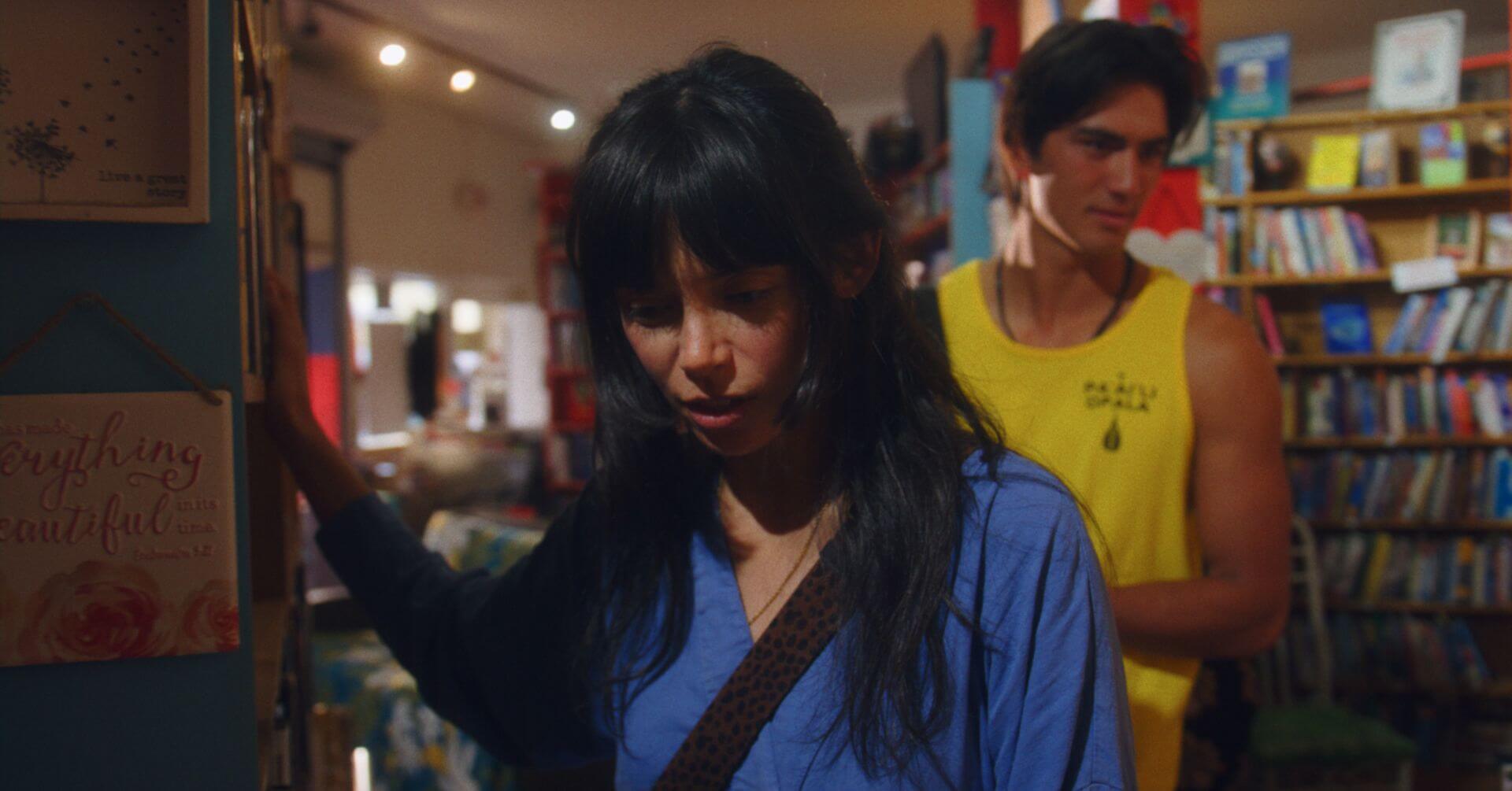
And the film as well, it's not only an indictment on her actions as well, which are obviously difficult to square sometimes, but also on society at large, the boxes that she's put into, the pressures. I think we see a lot of the comparison with her friend, who's clearly unhappy, and her brother, who is maybe held to a different standard than she is. Why was that important for you to also keep that aspect in as well?
Yeah, I'm lucky in that my family and loved ones have always accepted art as a viable and even admirable career to go into, and I know that's not the case for some people. But I used to work before I was working in the arts. I worked in a corporate setting where I didn't really feel like my personality matched any of the people around me who are really focused on promotions or family or whatever. I knew that experience of feeling alienated from everyone around me, who were supposed to be my peers, and who do you gravitate towards when you feel alienated by the people who you want to understand you? And Misha, I don't think [she] was doing anything wrong until her alienation brought her to make terrible choices through lies of omission. I feel at the beginning, I mean, she's held the same job for 15 years, which a lot of people cannot say. That takes real grit, determination, and hard work, even if she doesn't want an upward mobility trajectory. And I just don't feel like she's a slacker, but it's so funny how many people — both on the screen in the script — reading the script and reacting to the film are like: well, she's a slacker, it's a slacker film. I'm like, I don't think she's a slacker at all. I think she is satisfied with something a little bit more simple, which in American culture, we just usually are not.
Yeah, that comes across a lot in the movie as well. Obviously, the difficulties of coming up in the arts, working in this industry, and having people kind of respect and understand the process, the slow process of it. What advice do you have to indie filmmakers, maybe that aren't on the mainland either, things like that, and trying to get their goals furthered?
I found that with my filmmaking work, it really started to blossom after I became very entrenched in my film community. The Hawaii film community is small, and so we all help each other on projects. And it really wasn't until I started doing that that I found support for my own work in a real, organic, and natural way. And I think that in all industries, but filmmaking especially. I'm faced with a lot of culture in places other than Hawaii, of people who are looking out for their own projects first. When you meet someone, it's like, oh, where are you on the call sheet? And can you help my career? And there really is less of that mentality here because we are on an island, and a rising tide lifts all boats. And I really found that to be what unlocked my success. And Chaperone, that's why I cringe when I was like under my own vision because it truly was such a collaborative effort. Even a beautiful point is that it was a low-budget film, and most of our gear, our camera equipment, was donated for free. And that was through a connection I had once programmed a filmmaker's first film, like eight years ago, it was his first short film I programmed, and eight years later, he's working for a rental house, and he gets me this incredible deal that allowed me to shoot my film. And so that's the kind of relationship that I'm talking about, where we're all helping each other, and it's coming back. And so I think that if you're just starting out, instead of thinking, how can I get my foot in the door to get my projects made? What holes are there that I could help fill? How can I contribute to other people's work as I'm learning and growing myself?
And you mentioned a lot the importance of building that community in Hawaii. And we talked a lot about the through lines with like moral ambiguity themes that you want to continue with. Are there any themes in subject matters that you think drive you as a filmmaker? And specifically, do you feel like Hawaii and showcasing Hawaiian culture are a big driving force in your filmmaking?
Yeah, there's nuance here. I don't feel like my films showcase Hawaiian culture, because that's an entirely different thing, but they do showcase, I think, my community that lives here, which is quite different. As a producer, again, we're talking about supporting other people. I still work as a producer, and most of the films that I produce are for Native Hawaiian directors, because, again, that's like, how can I help? How can I put forward the voices that I want to hear and that I want to see? So I would say, for telling true Hawaiian stories, that's the way that I can support there. But I, again, think the people that live here: we're 70% Asian American or Pacific Islander, which is quite unique for the United States. A lot of people here don't believe that we are part of the United States, you know? And so I really want to help make sure that the people living here can see themselves on screen.
That brings me to my last question for us today. The ending, without giving too much away, leaves you in an ambiguous spot. You're not quite sure how much Misha is growing or not growing. You're kind of left wondering. And so, without putting a stamp on it one way or the other, how do you view Misha's future?
I view this film as a tragedy, and I hope that that's not giving too much away because I'm talking about structure, right? A comedy character learns and grows and does better at the end, and a tragedy, perhaps they don't, and that's how I see Misha. I see Misha still returning to the life that feels good and safe to her.
All right, well, thank you so much for sitting out and talking to me. This was such an interesting movie, and I had such a great time watching it.
Thanks, Sofia.
Chaperone is available to watch on VOD and digital.
Transcribing film interviews or festival Q&As? Save hours of editing with Notta—automated, highly accurate audio-to-text transcription built for journalists and researchers.