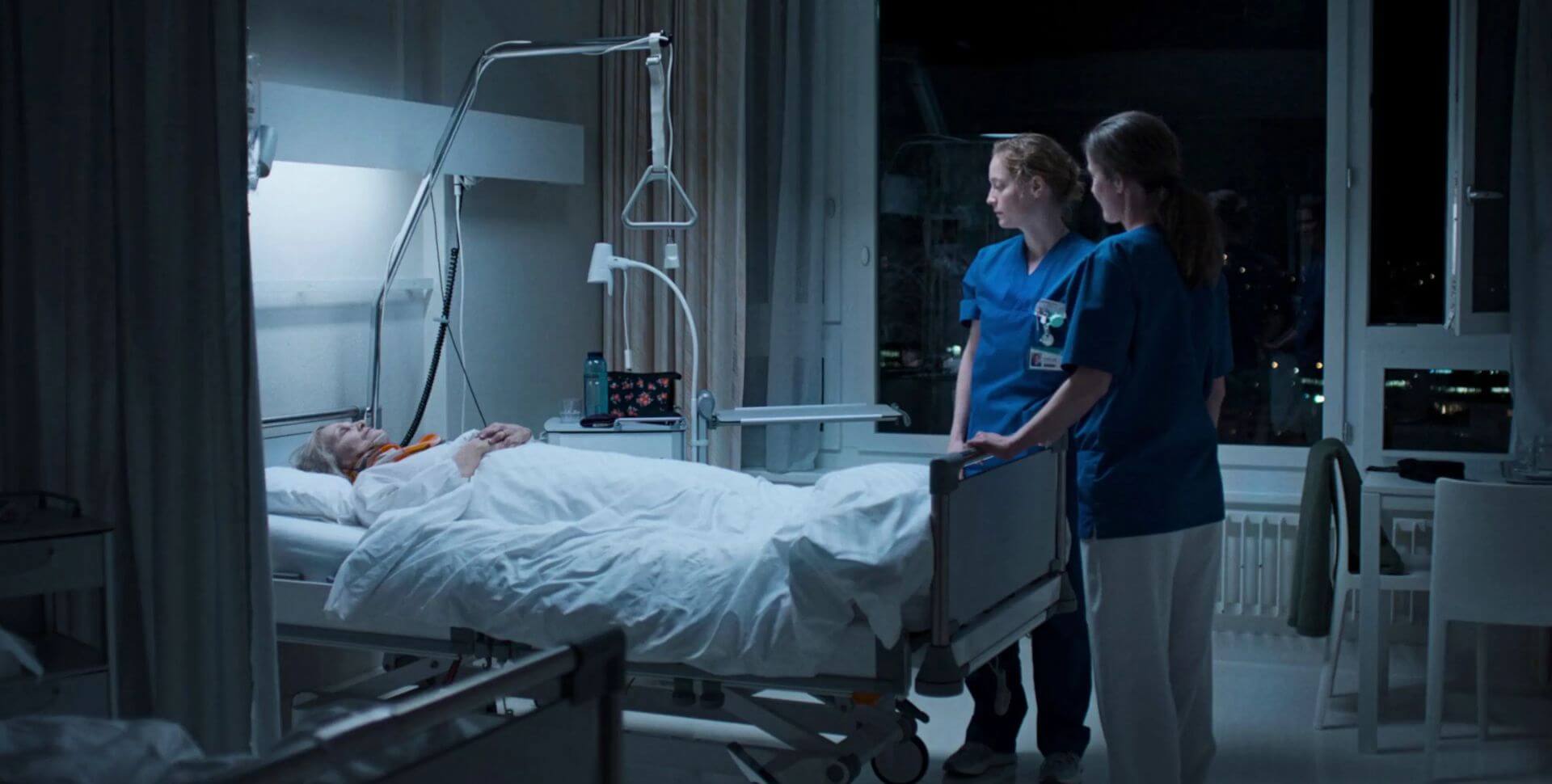
Floria (Leonie Benesch) is a nurse committed to performing her duties even if a late night at an understaffed hospital tests her limits.
Petra Volpe’s frantic medical drama uses long takes and panicky situations but never resorts to soapy spectacle. Written and directed by Swiss filmmaker Petra Volpe (The Divine Order), Late Shift is set entirely over the course of a night as Floria and a colleague tirelessly devote themselves to a barrage of patients. From an aging woman with dementia to a patient suffering an allergic reaction to the wrong medication to even a bratty entrepreneur with stomach cancer throwing tantrums in his private ward, all of these cases are tailor-made for chaos and disaster. As the camera frantically follows Floria, maneuvering through dingy hospital rooms, the film establishes its anxiety-inducing world right from the start. And yet, unlike any trite medical dramas, Volpe’s screenplay (drawn from German nurse Madeline Calvelage’s novel Our Profession Is Not the Problem. It’s the Circumstances) retains minimal dialogue and doesn’t gear towards any preachy monologues. With the doctors calling it a night and leaving behind an unpredictable shift on the overworked nurses, there’s not much time for any cinematic Florence Nightingale moments. In neither glamorizing the profession nor pleading for the audience’s sympathy, Late Shift serves as both an effective workplace thriller and a documentary-style exploration of contemporary nursing.
Leonie Benesch single-handedly carries the film in a timely call for better safeguards for medical frontline workers. Apart from its grounded realism and dynamic tracking shots, what makes Late Shift a nauseatingly memorable experience is Leonie Benesch’s calm and controlled act. The German performer has been racking up her credentials as “the stressful woman” archetype, with terrific turns as a teacher in a moral dilemma in the Oscar-nominated The Teacher’s Lounge and as an interpreter during the Munich Olympics attack on September 5. Rather than succumbing to typecast, Benesch effortlessly reinterprets these morally conflicted characters with a chameleon-like bravado and a thorough understanding of the source material. In Late Shift, too, Benesch sinks her teeth into the character, emoting as distantly as a real-life nurse who might have to deliver earth-shattering news to a patient at the drop of a hat. At the same time, she carries the compassionate energy of a caregiver who must provide warmth even if she’s losing her sanity on a graveyard schedule. Watching Benesch bottle up her frustration in the rich patient’s private room to find her singing a German lullaby to put another general war patient to sleep, it’s the kind of powerful, layered performance that deserves to be talked about for years to come. By the time the film features real-life statistics of a global shortage of nurses and their rates of leaving the profession, you begin feeling even more strongly for Benesch’s protagonist and the unfair circumstances thousands like her face daily.
This nerve-racking recreation of a night shift doubles as an immersive medical thriller and an empathetic drama on overworked nurses.

Late Shift is showing in select theaters in NY and LA, expanding soon to a national rollout.