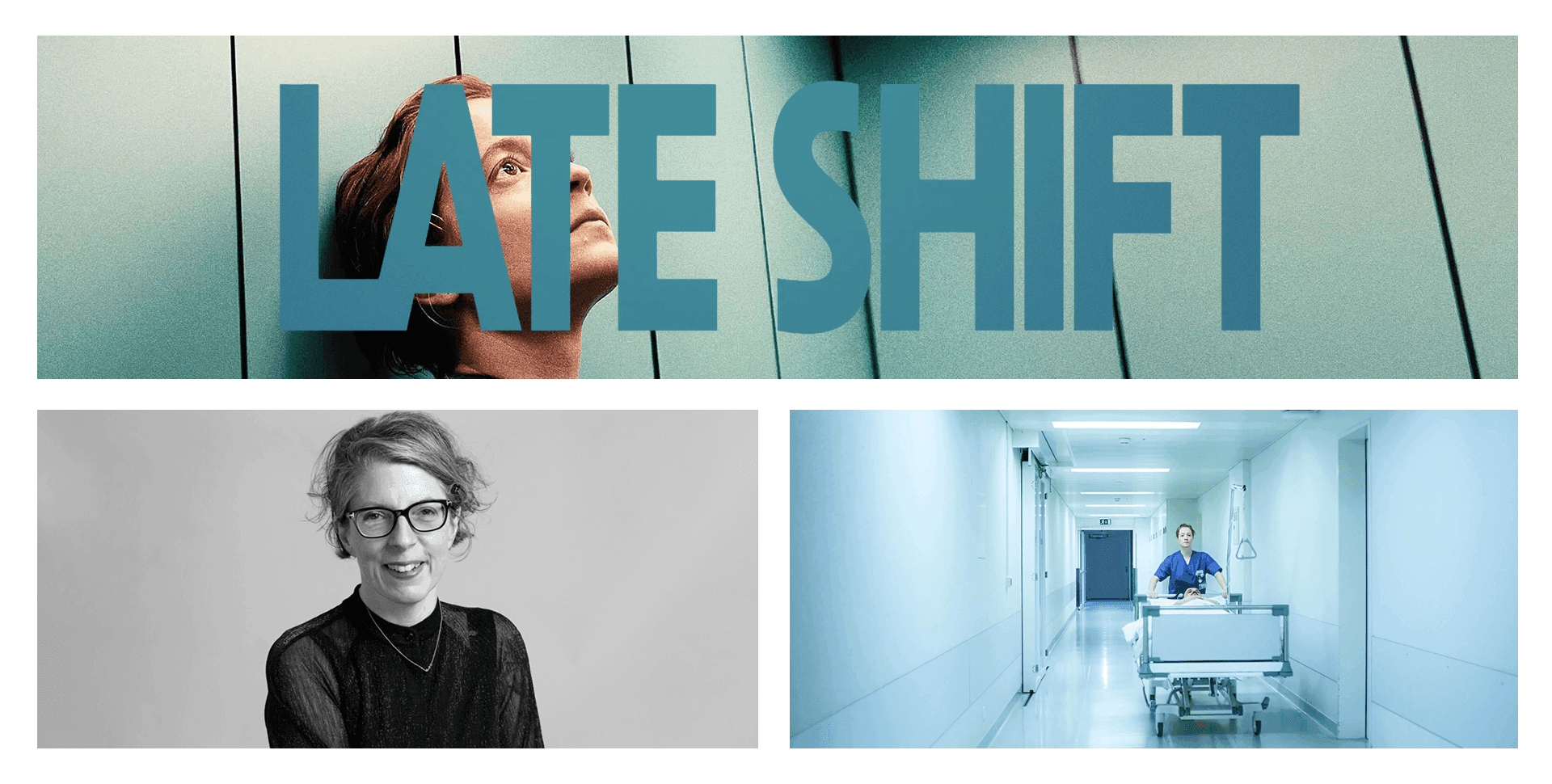
On the surface, Late Shift comes across as an anxiety-inducing medical drama as we follow a nurse on a graveyard shift at an understaffed hospital. But as Swiss filmmaker Petra Volpe breaks down her research, interactions with healthcare workers, and concerns for an understaffed medical future, Late Shift becomes much more than just a riveting human drama. In this conversation, the director reveals how she set out to undo cliched nurse tropes in medical dramas, how they filmed it all in an abandoned Zurich hospital, and how Late Shift doubles as a “cry to arms” for better care for those who care for us.
Listen here. The following transcript has been edited and condensed for clarity:
Hello, everyone. Welcome to the Borrowing Tape podcast, Behind the Lens. Today, we are joined by the Swiss filmmaker Petra Volpe, who directed the Swiss-German medical drama Late Shift. As the title suggests, is about a chaotic day in the life of a nurse on a late shift. As a nurse deals with a whole lot of patients in an understaffed hospital, you can't help but feel for her. Petra, when I watched this film, there were moments when I just felt like I could jump inside the screen, give the nurse a hug, and tell her it's all right. So welcome to the podcast and congratulations.
Thank you.
Now, this is not an easy film to make, because it just feels so realistic, documentary-like almost. Where did the idea for the film come about? What led to the origins of Late Shift?
I've been thinking about making a movie about nurses and the work of care for many, many years because my parents worked both in the hospital, not as nurses, but in sanitation and secretary. I worked as a nurse help when I was a young student for one week, and then I lived with a nurse for many years, and I could just observe what she was dealing with every day. But I was looking for a very particular form because I was also very aware of the discussion around nurses and the problems they face, like the worldwide (nursing) crisis and the shortage of nurses. And I read this book by a German nurse, Madeline Calvelage, who describes just one shift, which gave me the idea for the film's form. I thought it was just one nurse, one shift, and I pitched it to my producer, and he was like, "I'm in." Which was quite astonishing because it doesn't sound very flashy. From there, I took time to do a lot of research. I did dozens and dozens of interviews with nurses, I went to the hospital myself, and little by little, the particular shift that we see in the movie came together. And Madeline, who wrote the book, was a consultant, but the movie is not the shift she describes in the book. It's something that happened over time with all the research I did. And for me, it was really important to make something that's very abstract for people, like the nursing shortage. But what does that actually mean? What does it mean for the patients and the nurses? And it was very important for us to make a movie that makes it, as you just described in the beginning, you want to jump in, or you feel like you're with her all the time, and you really go through this with her.
And was it always your plan to make this film so intense and stressful? How did it come about?
I really took inspiration from reality. I wanted a real depiction of what a nurse does today in a hospital, on a ward that's understaffed. And it didn't even really take dramatization, because when I was observing them working, that's the pace they have. That's the stress level. This is a pretty normal shift. Whenever I had big screenings in Germany and Switzerland, where the film was already in cinemas, and there were 400 nurses in the audience, most of them said, 'This is pretty much my everyday life.' Not every day, but most days. So I try to stay very close to reality to make people understand that how complex the work of a nurse is today and how high paced and how extremely demanding, on a professional level, on a medical level, on a technical level, but also on a human level that amidst of all the stress, they also have to stay compassionate, or they find the compassion to be good to their patients and be there for them.
While you were making this film behind the scenes, because you're showing something so real, how much is too much to show on screen? How much tension in these real-life people is too much to show on the screen? You wouldn't want nurses or healthcare workers to watch and just feel triggered. There's hope they're celebrated as everyday heroes, and that they're just going back home after whatever happens. So, were there any moments when you were writing or directing this film that you felt like, okay, like, how do I balance the dramatization and the realism, and also not to make it that traumatizing for you [the viewers]?
Yeah, that balance was very important because you also need to have time for feelings, right? If you are so close to the character and the character is going through such an intense shift, and she only has very little time for her patients, that's the reality today. But of course, for the emotionality of the movie, it was very important that we do get to know the patients a little bit, that we do have a moment, a beat as an audience with her to feel something about this person. That was a very, very fragile balance to figure out in the writing, the staging, and the editing. It took the whole process to find the perfect balance for that. I think a lot of nurses were saying that they feel they want to jump in and help her. So, I did want it to feel real for the nurses who see it because they are rarely depicted in an authentic way. Very often in hospital dramas, the doctors are at the center of the narrative. There are very, very few exceptions. And they're driving the narrative. They are the heroes and heroines. And the nurse is usually somewhere in the background, and people have a very distorted image of what nurses do today. We really wanted to stay very truthful and give the people who are not nurses a very clear idea of what the work is.
What you said, it just made sense to me because there are so many medical dramas where I've seen the doctors, these Grey Anatomy and these kinds of dramas. But when anybody says the word nurse to me, sadly, I'll just get reminded of Florence Nightingale, or The English Patient, Juliette Binoche's character.
That's also a problem, because nurses have been notoriously undervalued in society. We take them very much for granted. People don't think about nurses; they're just happy they're around. But if you're ever in a hospital, you know that the main character in your life as a patient there is the nurse. She is there. And it's mostly a she because 80% of the people who work as nurses are women. And that's also one of the reasons why the job is so underrated, underpaid, and undervalued. For example, The Pitt does a really good job. I'm sure you know, it's a great... I love the show. And there are a few nurses that are really important, but still, the main characters, most of them, the majority are doctors. And of course, in the ER, they are more close to the patients. But in reality, the doctor comes five minutes in the morning and five minutes in the evening. And I'm not saying they're not important, but we need to say nurses are equally important.
Yeah, definitely. It's like the doctors are coming for five minutes and take all the spotlight in the films.
Yeah.
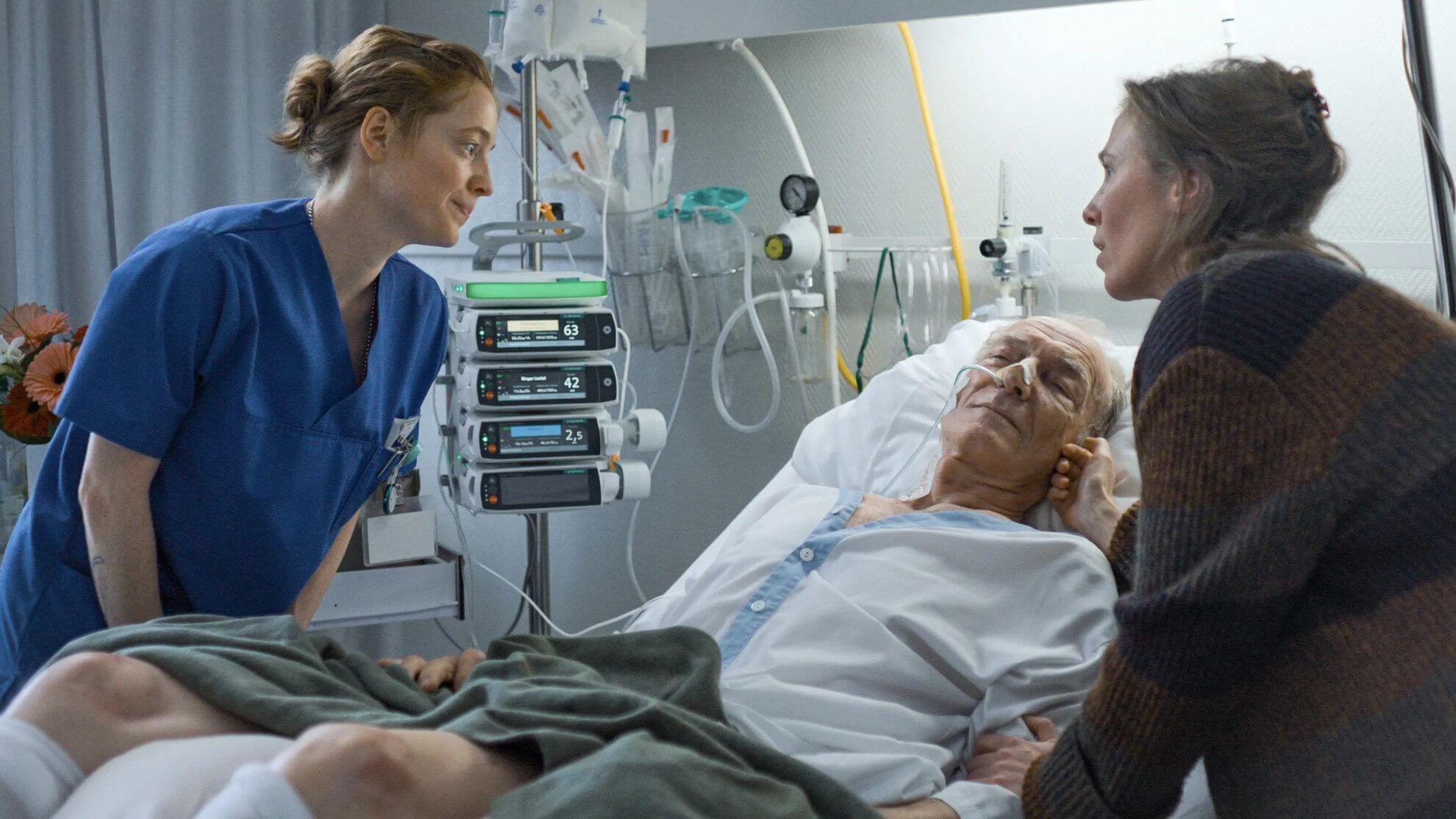
Talking about the actors, the heroine in your film is played by Leonie Benesch, who, I believe, is great in films with stressful situations for some reason. I loved her in The Teacher's Lounge; I felt bad for teachers. She had a similar role in September 5, where I felt bad for translators and journalists in a situation like that. And now, in Late Shift, she is a nurse and is being described by some people as one of her career-best performances. How is the experience of directing an actor like Leonie Benesch?
Leonie is just an amazing partner to have in a film like that because she brings such a visceral approach to a role, and she was very intrigued by the physicality. I pitched it to her: This woman doesn't have a psychological problem; she doesn't have an agenda. We're not talking about hidden intentions; she wants to do a good job, and that's the role. It's a woman who wants to do a good job. She really responded to that because I think for her it was a challenge to see the work of a nurse as a choreography also, and to figure out how to depict Floria, somebody who's worked in the job for 10 years, and that's a huge challenge for an actress, and so she threw herself into the role.
She went to the hospital to observe nurses and shadow them. Observing the pace, the rhythm of the work, the way they talk to patients, the way they talk to each other, to really figure out the tone, and then she had a coach, an ICU nurse who was also my consultant on the set. She basically trained Leonie like an athlete; she was practicing all the things that nurses do. She took all the material to her hotel room; she would practice in front of the television. She was always telling us that the people at the hotel would look at her really strangely because they thought she was maybe some crackhead or like somebody with a drug habit because she had all this medical equipment in her bedroom. For her, it was a matter of showing respect to the nurses; to really do a good job because we wanted to create a love letter to nurses, so we really had to nail it, because nurses are also a very strict audience.
Obviously, the entire film is set in a hospital over one shift. So what were the biggest challenges in doing that? Were there any issues with the space or camera movements? There are so many long takes in the film. Were there any technical problems for you?
I mean, the challenge overall was that we make the people feel that they see eight hours, like seamless eight hours. That they're there for eight hours. But we tell that in 90 minutes. How do you conceal that there are things we can't show? That was — on a technical and narrative level — a challenge. To decide what we show, and what we don't show, and how we can manage so that people don't notice that we don't show something. So that they really feel they're with Floria for 8 hours.
These long shots were — of course — a huge challenge, because there's always a lot of actors and extras involved. And we just practice them very, very diligently. And Judith (Kaufmann) —my DP and I — I've worked with her now for the third time. And she's like an amazing director of photography. We rehearsed with the iPhone. We did all the scenes with the iPhone and me as a stand-in to figure out the rhythm of the scene. Then we did everything with Leonie. Then we had two days where we staged the long shots and went through them with the Steadicam operator until it was really fluid. I think on the day when we were shooting, when we got it the first time, it was almost too perfect. And then, we fucked it up 16 times. Then the 17th time, I think it was the perfect one. No, the 17th time was too perfect and too smooth. I think the next one had the perfect balance of like, perfection with a little bit of things that were lively and kind of unexpected.
Where was this hospital? I believe it was a real hospital, or was it a set that you created?
It was an empty hospital. It's a hospital near Zurich that they were cleaning out. Just before we came, they shipped all the equipment to Ukraine to support the hospital there. So we had to get everything from other places, which was quite a challenge. My production designer, for example, found cheap beds in Germany, and then they were shipped to Switzerland. But then the beds didn't fit through our doors. Then we had to ship them back. We also needed our nurse consultant to help create the pharmacy. We had two floors in that hospital: one where we were shooting and one where there was makeup, costume, and the technical department.
It can be pretty gloomy, I believe, to film in a hospital, the situations that you're filming. Was it mentally affecting you in any way while making this film?
I love this quote by Susan Sontag, who says when you become sick, you become a citizen of another country. I think there's such a truth in that, because there's a particular loneliness that comes with illness. And it definitely was something that was always there, that all the people who played patients were very vulnerable. It was important to create a very gentle, empathetic, and loving set, so this vulnerability could have a space while we were shooting. We would also take breaks and let people feel things, because they also had to go into some very dark places, like the woman who was a mother and has cancer, it affected her very much to have these two children actors. It was really important to be very gentle and mindful with each other, and my DP and I made sure that everybody felt they could trust us, that there was no stress, and that there was space for all kinds of emotions.
But we also had a lot of fun because we had these blood pressure machines, and eventually, all the actors always had high blood pressure when they were in front of the camera. In the end, the whole team was measuring their blood pressure, and everybody had high blood pressure. Everybody was then asking our nurse, what's wrong with me? Why do I have high blood pressure? And then she said, now everybody has to stop measuring blood pressure. We had to forbid the people to [not] do that.
Lastly, Petra, I wanted to ask you: a major issue this film explores is the shortage of nurses and attendants in hospitals, and how understaffed hospitals can be. When you were making this film, in your research, did you come across any facts about the reality of healthcare workers in Switzerland or Europe in general that really shocked you? And, is this film more important than what I thought I set out to make?
Overall, of course, you know about the shortage of nurses, right? Something intellectually read about, but to actually meet the women who are affected by this, who are burned out, and they still love their job. Most people, most women I talk to, and also men, said it's the most beautiful job in the world. I would choose it over and over again, but I cannot work anymore under these circumstances, and that just broke my heart. The moral injury that nurses experience when they show up for work, have a really hard shift, and then go home in the evening feeling they haven't done enough. They are scared they made mistakes because there was so much time shortage and pressure. For me, it was just so heartbreaking that there are people who are willing to do this job, who are motivated, but we don't create the circumstances that they can actually do the job well. It's very clear that in this world, it's profits over patients, and it's a global issue. It's not just in the United States; it's in Switzerland and Germany, and the demands of nurses are not taken seriously. And eventually we will all pay a very, very high price because everybody who lives in a human body will eventually be a patient if they don't just drop dead, right? They are extremely important people in our society. This movie is also a little bit of a “cry to arms”, and I want to amplify nurses' voices with it.
That sounds very profound. And Petra, like that, that makes so much sense. I'm living in London right now. Over here, we have the National Health Service, and it has similar crises to what I observed in the film as well. Sometimes I've seen that in London hospitals, patients get annoyed and pissed off that there's so much delay in their treatment or getting to know what their problem is. And more often than not, they tend to take out that anger and frustration on nurses.
Yeah, there's more and more violence against nurses, especially also I read about it in the UK; they're bitten, they're spit at, they're hit, they're cursed at, and people have become very egotistical. It's a huge issue, actually, the violence against nurses. And it's shameful. We should be ashamed as a society; we should be ashamed of ourselves.
All right, Petra, that was quite a conversation, and thank you for making this film. I hope it opens up more conversations about care for health care workers. They're caring for the entire world, but who is caring for them? It's a question.
Yeah, exactly.
Thank you for your time, Petra.
Thank you very much for a nice conversation. Thank you.
Late Shift is showing in select theaters in NY and LA, expanding soon to a national rollout.