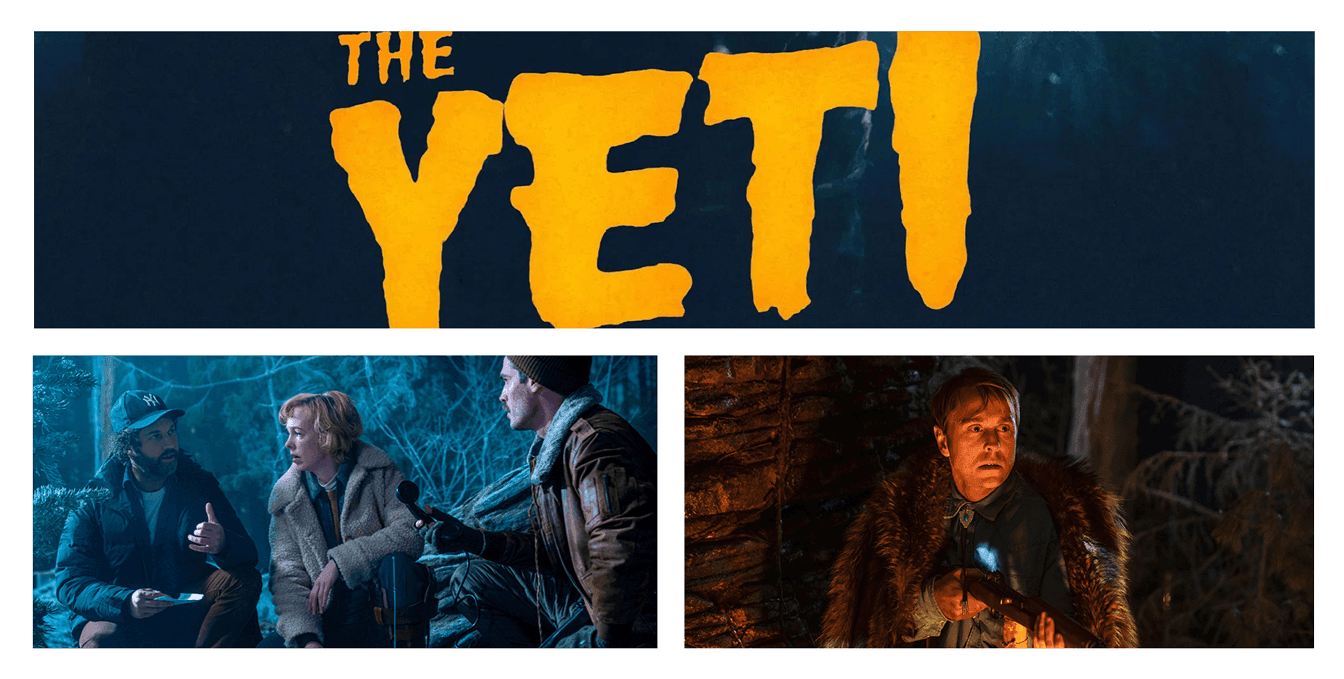
Creature features aren’t new to Hollywood, even though we’re yet to get a definitive film on the mysterious snow giant called “Yeti”. Writers and directors Gene Gallerano and William Pisciotta are trying to fill that gap with their aptly titled period-adventure-horror The Yeti. The duo talks to Borrowing Tape about the dearth of yeti films, rewriting the mythical creature’s historical origins, while letting us in on the secrets behind creating the gargantuan beast on set.
Listen here. The following transcript has been edited and condensed for clarity:
Hello everyone, I am Shaurya Thapa of Borrowing Tape, and today I am joined by William Pisciotta and Gene Gallerano, directors of the freezing new horror film The Yeti. Welcome, William, and welcome, Gene. The Yeti is a period horror set in 1947, where a rescue expedition in Alaska finds itself being hunted down by the titular beast, the Yeti, a.k.a. the abominable snowman—a monster that has dominated our popular imagination for quite some years now. William and Gene, the first and obvious question is: when did you decide to make a Yeti film?
William Pisciotta
In 2020, during the COVID lockdowns, I was watching a lot of movies, and I was looking for monster movies—specifically Yeti movies—and there just aren't that many. So I was like, "Maybe I have to make this so that I can watch it." And then I was calling Gene every day for six years, and finally got him.
Gene Gallerano
Will started calling me. He was like, "We have to make a Yeti movie. We have to make a Yeti movie." And as we kind of dug into it, Will was adamant that—and so correct—this had not been done before. It was unexplored, and there wasn't a singular version of the Yeti done like this. And we have an opportunity to put our stamp on what the Yeti might look like in a film for the first time and bring that to an audience. And that was really exciting and really thrilling to think about.
Yeah, I absolutely agree with you guys, because I have seen a few Yeti films where they were, like, abominably bad—no pun intended—very direct-to-DVD kind of films. Hopefully it ushers in an era for more King Kong, Jurassic Park, The Thing-style films. I actually got a lot of callbacks to The Thing somehow, watching the film. What kind of research into Yetis went into making this film?
William Pisciotta
A ton. I read everything there is to read about Yetis. We put a little bit of a different spin on it. Obviously, it doesn't take place in the Himalayas. There's a few reasons for that. Some of them are budgetary. But we wanted to go with this gorilla, Gigantopithecus, that existed during the Ice Age, and the idea that it migrates over to Alaska on the Bering Land Bridge and starts a family in Alaska. And so, we changed it a little bit. We wanted to put our own spin on it, basically.
Gene Gallerano
And I think that there's an allowance, because tell me what the definitive version is and why. Right now, they have to contend with the fact that there's an Alaskan Yeti that migrated from the Himalayas. If they want to go make their version, they totally can, and that's cool. I hope there are many other versions. I think that'll be cool. But you always want to try and have in the genre world, storytelling that's—like you said, The Thing—there are a lot of movies that are comparable to The Thing. We love that movie. The paranoia of The Thing is awesome, but there's also the mystery of The Mist or the adventure of Indiana Jones in the cellular makeup of this film. And I think that was all a part of it. We made a classic creature feature, but we also treated it as a character-driven film. The monster creates this pressure that everyone has to deal with. And so, in many ways, yeah, it's about the Yeti, but it's also about all these other people going on this expedition, and that's multifaceted in that way.
You mentioned Indiana Jones. Even I got that feeling. In some scenes it felt like I'm between the pages of an old-school pulp magazine or a comic book, because you have this ragtag bunch of American war veterans, geography experts assembled together against this mysterious threat. And because it's set in 1947, it somehow feels even more retro, more vintage. How important was it for both of you to make this film a period story and not a contemporary one?
William Pisciotta
Very important. It was always set in the '40s from the first idea that we had. I think there's just something about modern—it's not scary enough. It doesn't feel interesting enough to have a bunch of people hiding in the woods with cell phones and modern police. We wanted remote, nothing around, no way to contact anyone. They had to get there by ship. It's a whole thing. You can't just leave. It's very important.
Gene Gallerano
It's more fun. We live in a culture where, contemporarily, you'd use your cell phone and you'd get an SOS out or something, and they'd send the rescue helicopter. While they had rescue choppers in the '40s, it's just not as fun. I worked on this TV show about elite adventure athletes, and some of the places that they went to—so remote, so hard. Of course, the further you go back, the more remote it is, the harder the expedition, the more fortitude it tells you about the people that did it. You think of a Shackleton or something. They were animals. The Shackleton expedition—they were stuck on ice for 18 months, ate seal blubber every single day. You think about what we do contemporarily, let's just have a cell phone, let alone seven people, or however many people there are with cell phones. Pretty uninteresting. We're going to fight this Yeti with our iPhones.
I definitely agree with that sentiment. Talking about the expedition itself, obviously a Yeti film, irrespective of being in Alaska or Tibet or the Himalayas or wherever, it has to look butt-numbingly cold, and it does look cold. Your film looks freezing. I'm very intrigued to know: where exactly did you film all the outdoor scenes? How did you recreate that?
William Pisciotta
It's all shot on a soundstage, except for one shot in the movie at the end. Everything else we built. We built the forest, we built the cabin. We had a snow guy, Randy, who made sure there was snow.
Gene Gallerano
He had five types of snow that he was incorporating throughout. We had layers of fog. That was a part of the playground that we wanted to create—come along and join this adventure where we're going to build the outdoors on a soundstage. And we got really lucky to be able to do it in Buffalo. We had some master craftspeople that came along. For me, it just keeps going back to the idea of the film. People—we would talk to them when we were crewing up, and same with the cast. The people that we talked to, if everyone—we'd pitch them on our movie—every single person would say, "Wow, that's ambitious." And the ones that had that crazy behind their eyes, we're like, "Let's sign them up." And the ones that were like, "Oh, that sounds ambitious," and didn't think we could do it—it just wasn't gonna work. But that creates a happening, an event. And I think this goes into that technology and the CGI of it all, and the fact of doing it all practically. You feel an imprint on the film, like a handmade, analog version, which is not happening a lot right now. And I think that's also really exciting. That's also something that audiences have been really excited by, and the cast and the crew—everyone was really buying in on, "Let's go create. Let's go actually build this world and this set." And that's fun.
That sounds very meta, too. It feels like you guys were leading an expedition and finding the right kind of crazy creatives to join in. And yeah, let's take on The Yeti together. And lastly, my question is talking about the Yeti itself: How did you achieve creating that monster? Was it all practical, or was VFX involved? What was your frame of reference?
William Pisciotta
It was all practical. We had some of the best monster people on the planet working for eight months to build this nine-foot creature suit. Fully handmade, it's sculpted, only fits one guy. This guy, Robert, was amazing.
Gene Gallerano
Yeah, who was the sculptor's brother, right? Nobody else could have fit in it. Maybe we could have found somebody, but chances are pretty unlikely. The hair, the paint, and all of the eyes were custom and specially ordered, and took months for them to get their hands on it. So it's really a one-of-one and continues to be a testament to the film and just how the whole thing was made.
And if I may ask, what happened to that Yeti model or suit now? Is it dismantled, or is it in your living room?
William Pisciotta
Gene has the head. I have the body.
That's so cool. If I was filming a Yeti film, I would do the same, but that's really cool. It was lovely talking to you guys, Gene and William, once again, for the film. And yeah, here's to more Yeti films. Hopefully, we get a sequel in the Himalayas.
Gene Gallerano
Yeah!
William Pisciotta
Hope so.
Not to be a science nerd, but when you mentioned that this is your version of the Gigantopithecus, it makes total sense for it to be in Alaska, because I would like to believe the world was all one continent.
William Pisciotta
Yeah, exactly.
Yeah. I don't think geography matters.
William Pisciotta
They could be everywhere is my fun.
Gene Gallerano
How did we migrate over here? I have a friend in Alaska right now skiing, and if you told me those were the Himalayas, I would totally believe it. There's some amazing—like, the Denalis —there's some amazing land there. Yeah. Anyways, it's our version.
There are probably Yetis all over the world. And on that creepy note, I will end this interview. It was lovely talking to you guys.
William Pisciotta
Thank you.
Gene Gallerano
More Yetis, more Yetis.
William Pisciotta
More Yetis.