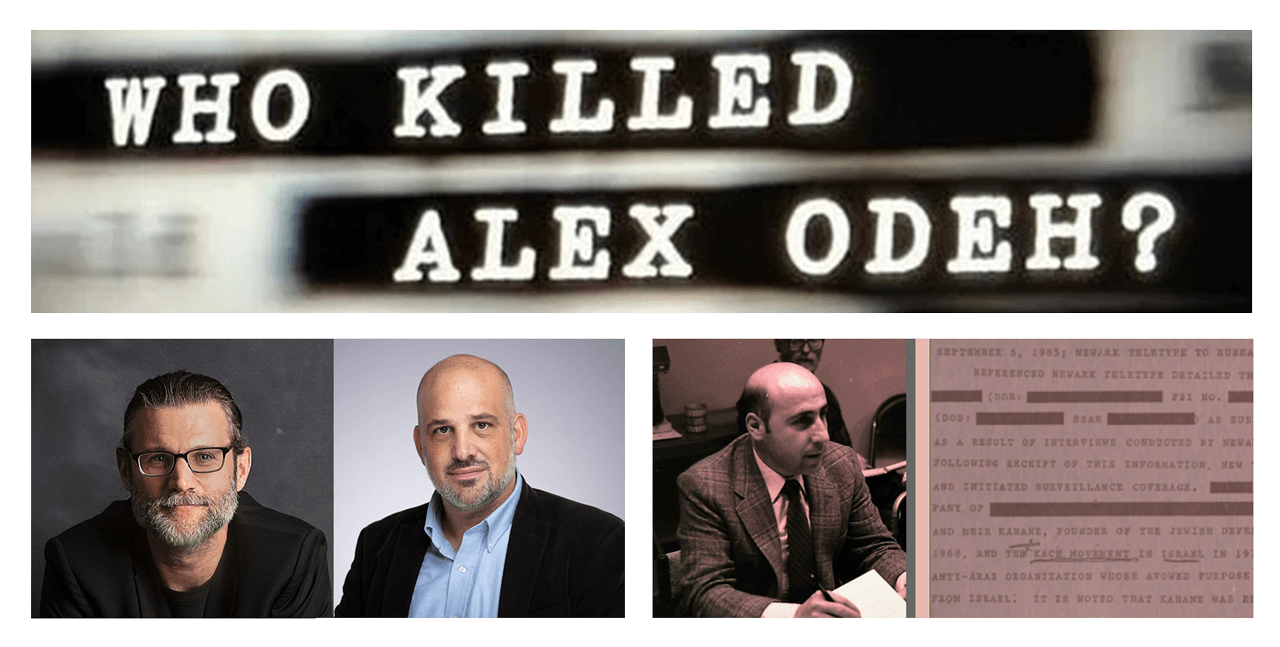
In 1985, Palestinian-American activist Alex Odeh was mysteriously killed in a bomb explosion in his office. The documentary Who Killed Alex Odeh opens not only this shocking and underinvestigated case but also digs deeper into the murky aftermath that spilled from America onto Palestine and Israeli homes. Directors Jason Osder and William Lafi Youmans break down their personal connection to Odeh’s story, the painstaking archival work, and the legal concerns over an “open case” like this.
Hello, I’m Shaurya Thapa of Borrowing Tape, and today, I’m joined by Jason Osder and William Lafi Youmans, directors of the new documentary Who Killed Alex Odeh? that celebrates the legacy and investigates the death of American-Palestinian teacher and activist Alex Odeh, who was assassinated in a brazen act of political violence in 1995. For decades since then, Odeh’s death hasn’t been fully solved, with some of the perpetrators having disappeared or gone into hiding.
Jason and William’s documentary attempts to probe the biases and lack of accountability that followed the community leader’s demise, relying on investigative journalism that takes viewers from the US to Palestine and Israel.
So, Jason and William, this is an essential documentary in showing how justice for Alex Odeh’s murder wasn’t delivered even after a decade of evidence. What drove you to direct a documentary about this subject and this case?
Will: I grew up with Alex’s story. As a child, I joined relatives going door-to-door recruiting members for the American-Arab Anti-Discrimination Committee (ADC), the new organization Alex was part of when he was killed. The murder deeply affected our community, sending a chilling message about the risks of speaking out for the Palestinian cause. It was very much part of my political socialization.
When I later saw Jason’s film Let the Fire Burn, I was struck by its parallels to Odeh’s story. Both events occurred in 1985, and the connection felt immediate. During a post-screening discussion, someone asked Jason about his next project. He said he was looking for ideas, so I pitched Odeh’s story. He agreed, but only on the condition that I co-direct the film with him.
Jason: For me, the story was new, but as Will said, it resonated with my earlier film about the MOVE bombing in Philadelphia, also in 1985. Both incidents spoke to systemic violence against marginalized communities and impunity. More than anything was the sense that if you grew up at that time in Philadelphia, the story of MOVE was part of your history, but outside of that area, many Americans knew nothing about it. The way Will talked about the Odeh murder was very much the same, and that struck me as vital.
While researching Odeh's life, what kind of archives or multimedia material did you come across? Did the research provide any revelations to you?
Will: One of our biggest challenges was building a visual archive of Alex Odeh. As a community organizer rather than a public figure, and as a member of a marginalized community that was often overlooked by mainstream media, very little footage of him existed. We found far more coverage of his assassination than of his life. However, community members played a crucial role in preserving their own history by recording local TV broadcasts of the murder that otherwise might have been lost.
A major breakthrough came through Arab American TV (AATV), a weekly Los Angeles program that Alex helped promote. During the COVID lockdown, AATV founder Wahid Boctor sent me thousands of tapes from the program’s archive. After digitizing them, I found only a few minutes of footage featuring Alex himself, but the collection proved invaluable. It contained extensive interviews with his family after his death and coverage of community commemorations in his honor.
I also accessed ADC’s paper archives of his work, and I got to see just how energetic and efficacious he was as an organizer. He was clearly someone who worked tirelessly, which could only mean he genuinely believed in what he was doing.
As your film reveals, Odeh was constantly hounded by American and Israeli extremist groups. The security forces were also not very helpful. During your research, what do you think was it about Odeh that scared such extremist forces?
Jason: Will and I tend to have slightly different perspectives on this, but for me, part of it was Alex’s moderate politics and bridge-building style of activism. He truly sought to foment dialogue between different perspectives, and that is a threat to extremists.
Will: I agree somewhat. Alex tried to build relations with the American Jewish community around him to promote peace with justice. This completely undermined the extremists who painted Palestinians as evil and inherently anti-Semitic. That said, I do think they believed Alex was involved with the Palestine Liberation Organization (PLO) and that killing him would be vengeance for Palestinian attacks in the region. It was a very tribalistic calculus.
Were there any legal challenges or backlash that you faced while documenting a subject like this?
Jason: Well, it is considered an open case by the DOJ, so we could never get the federal authorities to talk to us on the record. We were able to learn some things through FOIA and other sources, but as far as the official investigation, there is still a lot we don’t know.
Will: We faced some backlash; by that I mean harsh critique and perhaps lost opportunities, because we did not simply frame the suspected killers of Alex as “bad apples,” but as linked to a thriving political movement. I do not want to give away too many details about the film, so I won’t say more.
A documentary on a headline-making case like this can delve into shock value, or it can become just a generic work of true crime sensationalism. How did you actively try to avoid such genre tropes to craft a film that’s more sensitive and respectful of Odeh’s story?
Jason: It was very important to us to respect Alex’s legacy and render his family in a well-rounded way. We also wanted to include the politics and the history: not only the who, but also the why. Hopefully we succeeded in this, but it was definitely a balancing act. In both cases, in how we depict the family and how we depict the political background and context, we learned that it was not quantitative. Meaning, more time with Helena and Norma didn’t necessarily mean more humanity. We had to find the moments, the beats, that audiences could relate to.
Will: It helped that I felt a personal connection to the victim, here, Alex. He was not just a prop for us, but someone who really mattered. Also, Jason does not do sensationalism. Let the Fire Burn was a strong narrative because of how soberly a harrowing crime is recounted. It respected the audience to feel and think. I think this film has much more affect in it because of the family’s role, because the film has contemporary footage to show how Alex’s loss stayed with them.
How involved were Odeh’s family in the research and development? Were there points when you avoided contact with the family to pursue the truth in your own ways?
Jason: Yes, for sure. We checked in with them pretty frequently, but there was a lot we pursued on our own. We didn’t want to subject them to all of that, and it’s also not what they do. When we found something really notable, we would let them know, as we never wanted them to be surprised, and we always wanted them to hear directly from us.
Will: I would also add that we worked with them over many years and timed our encounters to coincide with key anniversaries when they would tend to feel heightened sadness. So this meant it was common to go for nearly a year without being in touch. They let us know of developments from time to time. They did not play much of a role in research, but they began proposing scenes to shoot towards the end. Some of the most powerful parts in the film came from their initiative. It is perfect when “subjects” who were once reluctant come to the comfort level and investment to do that.
Jason and William, both of you come from academic and activism backgrounds. How do these fields overlap in a format like filmmaking? What challenges do you face balancing such career trajectories?
Will: It is tricky in that when it comes to my academic career, it is not clear how filmmaking is to be evaluated by peers. That said, being in a discipline like media studies, it is much more flexible since filmmaking is also something that is studied and taught. But we’ll see when I have to apply for promotion.
I see them as closely related. Scholarship helps me research, contextualize, and analyze events, while activism keeps me connected to the communities and issues those stories affect. Filmmaking sits at the intersection of the two. It allows me to combine research with a form that can reach audiences far beyond the classroom or an activist meeting.
One challenge is balancing advocacy with historical and journalistic responsibility. Another is that what makes a film good and what makes scholarship good are, for the most part, opposed. I had to unlearn the PhD in filmmaking as Jason emphasized narrative, pacing, characters, and affect, rather than just thematics and evidence. If the film is too packed with information, that is my fault!
Jason: It’s different for me, as my background actually is documentary filmmaking. I just happen to also be a teacher and practice my craft in the context of a university. Historically, there have been some tensions between practices like documentary and more traditional forms of scholarship, but generally it is more well understood these days. Many documentary filmmakers have university positions. It’s sort of like being a poet. No one makes their living on that.
Considering your documentary covers such a long-delayed case and some undercover footage of Israel-based settlers admitting to extremism, were there any fears of legal backlash while making this film? (especially given the post-Oct 7 context when Palestinian documents continue facing online attacks or censorship from certain sides)
Jason: I think there are always fears. There have been no lawsuits or legal threats. However, as you see in the film, the JDL never sued over accusations about the Odeh murder. One theory is that they are afraid to draw attention to the facts and open themselves up to a discovery process, but we don’t really know.
There was a period after Oct. 7, 2023, when we were unsure if gatekeepers would have the courage to program this film. For a while, we were submitting to festivals and being rejected. During that time, we kept working on the film and making it better. When we were finally accepted to Sundance and then Berlin, Will asked me if I thought the film had improved or the environment had changed. We settled on both.
Will: I would also add that I was worried our film’s title would be shadow-banned on social media because of the words “killed” and “Palestinian.” The platforms hosting the public sphere have become hostile in many ways. But the word is getting out about the film. I hope everyone sees it.
Opening theatrically in New York at The Quad Cinema, Chicago at Uprising Theater and Los Angeles at Laemmle Glendale on October 30, followed by a nationwide rollout, then November 24 debut on Watermelon+ as well as all VOD Platforms.
Transcribing film interviews or festival Q&As? Save hours of editing with Notta—automated, highly accurate audio-to-text transcription built for journalists and researchers.