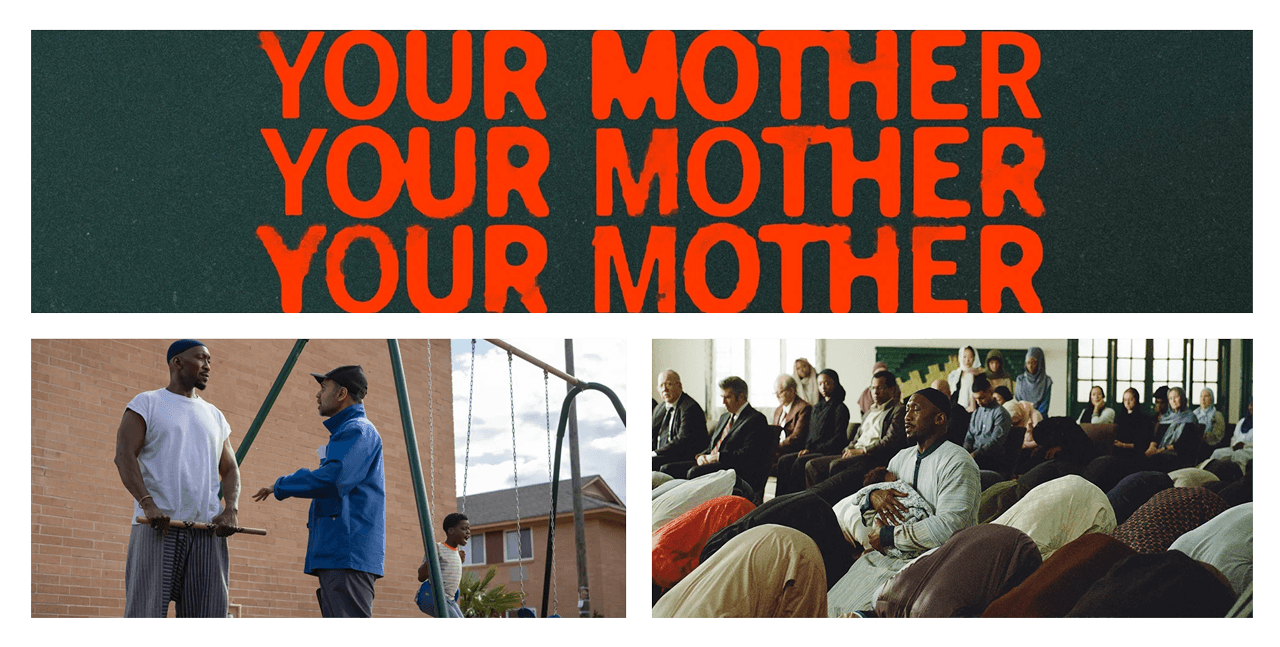
Director Bassam Tariq and two-time Oscar-winning actor Mahershala Ali had raised eyebrows a few years ago when it was announced that the duo was working on a Marvel film on the character Blade. But when Marvel controversially scrapped the project, Tariq and Ali joined forces again for Your Mother Your Mother Your Mother, a gripping action thriller doubling as a moving family drama and an introspective exploration of a Muslim hitman's conflicting faith. Borrowing Tape caught up with Tariq at the London Film Festival for this interview, where the filmmaker discusses filming sword action, the pressures of representing Muslim heroes, and why his filmography carries a bit of Bollywood in it.
Available to stream on the following platforms:


Listen here. The following transcript has been edited and condensed for clarity:
Hello, everyone. I am Shaurya Thapa of Borrowing Tape, and today I'm joined by the writer and director of one of my most anticipated films of 2026. I'm talking to Bassam Tariq, the man behind Your Mother, Your Mother, Your Mother. Some might tell you this is an action film starring Mahershala Ali, but I can assure you that this is more than just an action film. Mahershala Ali plays Latif, a contract killer with a moral code and a moral conflict. He's grieving the death of his wife, trying to be a good dad for his three kids, all the while managing a violent career and grappling with his faith. It's a lot to take in in this film, Bassam. How do you feel now that it's finally out for the public to watch?
And you did see the film?
I did. I did see the film.
Okay, great. Okay, awesome.
I saw the film twice.
Oh, wow.
I've been really on the bandwagon. If this film disappointed me, I would have been disappointed. When the trailer came out, I was already sharing all my stories like, "This better be the movie of the year." It was a few months after I saw Bait. The Riz Ahmed show. Some of the episodes which you directed, so, you know, I was fresh off the Bait hangover- ... and then I'm like, "Oh, there's another Bassam Tariq project. Of course."
Thank you, man. I appreciate that, man.
So welcome to the podcast, Bassam.
Thank you. Thank you so much.
As I said in my intro, there's a lot to take in in this film. This is not just a standard revenge drama. It's also a family drama. It's a religious drama. It's a philosophical drama almost. How did you come up with this idea? What led to the origin?
I've realized that everything I work on is: there's a lot of stuff happening in one. Maybe it's just the Bollywood in me. I don't know what it is; I want a little bit of this, I want a little bit of that. Every community, even in the film, has a song that they're singing. There are a lot of songs, and sometimes when you enter a space, there's actually music or somebody singing a song in these spaces. So that happens a few times. Even at the Pakistani restaurant, there's a song called Sweet Medina that my wife is actually singing in the Pakistani restaurant.
I don't really think in genres. I think that actually holds me back. And also, in the tradition that I come from, we don't think in genres. We just think in feelings. And I think when you think in feelings, you just allow those to actually speak for you.
That makes a lot of sense because, I mean, because I come from India, right? And India and Pakistan, we're all the same subcontinent.
Yes.
Our films—it's a stereotypical term—but I still agree: our films have a lot of masala in them, which is a mix of everything. Mahershala got a lot of mass entry scenes with his blade, with the sword and all.
Let's just get to the title of the film, which, of course, is from a hadith, which is explained in the film, where the Prophet said, "Your mother," three times, as to the person who deserves the best of you.
The hadith is a collection of sayings of the Prophet because oral traditions are important.
Now thanks to this film, a lot of even non-Muslims would know about this hadith, or probably that would even intrigue them to check out more of such traditions. What was your personal connection to a hadith like this? When do you recall this catching your fancy? Even before the film?
As you know, being South Asian, our mothers are always telling us how important they are in our lives. This was something I always knew, but I think it was when I saw my wife become a mother that I started to realize that the connection that children have to their mother, and who she's becoming, is something that I don't actually fully understand. I'm seeing a mountain forming in front of me, and I have to be in awe of it.
Let's talk about the action now. There's a lot of sword fighting in it, which is a good refresher for me. I mean, no offense to John Wicks, and all the other films, which I like, but as Mahershala himself tells the imam played by Giancarlo Esposito, "I don't use guns." He has his code of using a sword. Tell me a bit about this obsession with sword fighting in this film and about the calligraphy on the sword as well, because it is not just generic.
I picked up the sword while I was doing Blade, and so did Mahershala. I was doing it more so from my own understanding of why people use a sword and what a sword teaches you. The biggest lesson that I've learned about sword wielding is that it is an extension of you. If you yourself are somebody who is anxious and you are wielding a sword, the sword is an extension of you. As you strike with your sword, if you strike with clarity, that means that you yourself have clarity; if you are wavering, then your sword will waver. And I love that. That's an extension of yourself. It's a mirror of you. That's different from guns, because I can just literally take a gun; I'm like, bam, bam, bam, I can shoot. A little kid can shoot up a whole Walmart with a gun, which is nuts. Whereas a little kid with a sword can't really do anything if he doesn't know how to wield it. It requires a lot of discipline, posture, movement, and clarity of your feet. It's a lot of footwork. I think seeing all that made me realize that there's something really deep with it.
It's also connected to calligraphy, and I wanted the sword to have meaning to him, but what I wrote on his dagger sword, the smaller one, was "مُوتَ قَبْلَ أَن تَمُوتَ," which means "Die before you die," and that's more of a reminder for him where he is seeking his death. That's actually also a Buddhist saying, too. I think the Prophet said it, but also Prophet Muhammad, peace be upon him, said it, and Buddha said it, too: that you want to die in this life before you die, where you're seeking your ego death. You want to have that unattachment to anything.
That's pretty cool because we usually don't see sword-wielding heroes in popular imagination. The last I can remember that I really liked was Forest Whitaker in Ghost Dog: The Way of the Samurai. Felt like a good companion piece to some of the scenes in the film.
Obviously, Bassam, I know you're not a contract killer in real life, as much as I know. But you are a dad. Did any of your own fatherhood journey make it to Latif's struggle to be a good dad?
The whole thing of being a father or being a parent, it's like a battlefield. I feel like, at least that's what it is for me. I feel like I'm constantly at war, and sometimes I'm actually at war with myself because I'm trying to be a better version of myself for my children. It's so hard to be present because every time they're making a choice or they're doing something that I think is incorrect. It's this catastrophic thing that I have to correct for them; otherwise they might become a bad person. Anytime they don't brush their teeth, I'm like, "Oh my God. It's the end of the world." I'm like, "What am I doing? Am I raising this kid that'll never brush their teeth?" And so, everything becomes really catastrophic. It's like a war zone, but I realized that I'm actually at war with myself [more] than them. I've been trying to piece that together, and that's why putting a backdrop of an action movie with it just felt correct. It felt like that anxious energy that I feel being a father, I could put onto the script.
Directing a two-time Oscar winner like Mahershala Ali, that's one thing, but you also turn him into a full-fledged action star, and the man is 52 years old. Doesn't look like it at all. Break down this collaboration with Mahershala: just directing him as a dramatic star and also as an action star.
Yeah. That was really easy. I think it was easy because he's an athlete, and between takes, he's got a jump rope, and he's jump-roping, he's doing push-ups. He is very aware of his body, and he is an actor who knows how to move his body, and not a lot of actors do that. What he's known for is his dramatic roles and his face and how he embodies character through his emotions. How he moves is something that I want us to see more of, and that was what I was really curious to push him into.
I have to give a big shout-out to Adam Hart, our stunt coordinator, who really also empowered Mahershala to believe in himself that he can do these things, and he saw it. He knows that Mahershala's got the talent. He says on his hand he knows five actors that he believes are incredible with stunts, and he thinks that Mahershala's one of those five. We were lucky, because if he wasn't good at that, oh my God, we would've probably had to just get a stunt dude doing everything, and that would've been a nightmare to shoot because there's so much emotion that we're losing then.
If you talk about the villain, a radical pastor played by John Cho, who seems to have formed his own kind of religious sect, and I just feel there's a lot of nuance in this film, not just with Islam, but also Christianity, because the Christianity that John Cho's antagonist practices is its own sect. Creating the story, did you ever have any fears that you would have any backlash? In a way, so that people don't misinterpret this as a simplistic Islam versus Christianity battle, like a crusade of our age.
Yes. Well, I think the important thing is that people see that many people are saying, the Muslims are even saying in the movie that, "Hey, he's like you." "He's a jihadi like you, but like Jesusy," right?
Sure.
It's like they're connecting. In fact, in some ways, Latif also really admires Pastor Hwan. There's something about him that he's curious about. The other thing that I would say about that is: I like that you called him an antagonist. I think at one point you called him the villain, but I'd see him more as an antagonist because I think they're one-to-one with each other, and he's more of an opposing force to Latif. But in another world, I could see where they're both on the same side, fighting for the same causes.
The concern of people seeing a simplistic battle between Christians and Muslims? Yes. I think, unfortunately, the Hollywood system can be really simplistic, but I think we were blessed with an incredible studio head in Alana Mayo, and she really believed in what we were doing, and of course, what we're building towards is grace. It’s more like a Miyazaki movie, like Princess Mononoke, where he made this epic war movie, but at the heart of it, you can't really place who the villain is, and everyone's in really complicated situations, and I love that.
Right from the trailer, when Your Mother, Your Mother, Your Mother came out, it's revealed that the character of Khadijah, who is the titular mother in question, is no more. She's dead, and her death kicks off the events of the film. But even if she's not there, I feel like her presence is almost ghost-like. It lingers throughout, not just Mahershala's character, but the actors playing as children as well, which I found to be a cool subversion of this dead wife or dead mother trope that we have in even the best of action films.
How did you approach that? Was there a draft in your script where there was more backstory on Khadijah, and why did you choose to restrain yourself a bit?
Actually, we had no backstory before. There was none, and then people were like, "You need something," and we felt it in the edit, something's missing here. So some of that stuff, we then got it later. What I would say is that we need to be with Latif on this story, and there's a lot of story we ended up cutting, a lot of backstory we ended up cutting just because it needs to be about his grief and the need for breast milk. Whenever someone's grieving — I thank God my wife is still alive — there is this feeling that when you're not ready to grieve, you don't wanna remember them. In some ways, he's not seeing all of her as a human being because she was a human being and she existed as a fully formed person, but all she is right now is a ghost because he is not in that place right now to actually sit with this grief.
So that's his way of grieving.
Yes.
You have played around with Muslim protagonists in many shades. Your work with Riz Ahmed found you directing him as a Pakistani-origin rapper in Mogul Mowgli. But the movie, again, is not just about him. His dad's Partition experience also gets incorporated. You also directed Riz Ahmed again as a Brown James Bond in episodes of Bait, and now you have a Muslim hitman questioning his faith. As a Muslim filmmaker yourself, what kind of pressure or responsibility do you feel to explore so many shades of Muslim life through a modern lens?
That's really a great question about responsibility. I think I can't deny that the current Western Hollywood, even in India [referring to the portrayal and villainization of Muslims in media]. It is crazy. It's nuts, and it wasn't like this before. In the Bollywood that I grew up with in the '90s. It was very different. There were shades of it, but not, not as crazy as it is now.
It wasn't bloodthirsty for Muslim blood as it is now.
Yeah, as it is now. But at the same time, I'm not an activist filmmaker. I'm not sitting here trying to change the world with films because that's too much of a responsibility, and I don't think anyone's interested in that. People can read whatever you're trying to educate them about, or make an after-school special. I think that's, nobody wants that. I don't want that either. I just love people in my community, and I write about those things, but there are other things I'm writing right now that have nothing to do with Muslims as well, but will deal with ideas and first principles that I connect with.
When I first saw the trailer, again, as I said, I was beyond excited. Looked really cool, but then, as you know, the world of online journalism works; I'm also part of that world. We go with clickbait, and you know how to sell a certain movie.
Even when you're complimenting a movie, I feel like the compliments can be a bit backhanded. That's what I felt personally when I saw a lot of people sharing the film's trailer and calling it Halal John Wick, Muslim John Wick, that kind of thing. Personally, just a consumer of that art, I find that to be a bit of a reductive label, limiting a character by calling him the Muslim version of another white character. How do you react to comparisons like that? Do you find it to be a bit monolithic?
You can't control the dialogue online. The thing that I try my best to do is to make the best possible version of the film that I can make. Then, the world takes it. I think this is the part of this that I'm learning right now because, God willing, this film is seen widely. Mogul Mowgli came out during COVID, and my films before that, they were quite small too, and they kind of just had their little limited runs. What I'm trying to do is figure out a way to be okay with letting go and knowing now that it's the people's film, and I've had my time with it, and I'm happy with the journey that we had. But now I've let the film out into the world, so now it's everybody else's.
You've played around with so many genres as well because you started with documentaries. Mogul Mowgli is, as you said, hard to fit in a genre. Because I've recommended Mogul Mowgli to a lot of people after Your Mother, and so when they ask me, "Oh, what's it about? What genre is it?" I'm like, "I don't know. It's a bit experimental. It's a drama as well." "There are some musical elements to it as well." You worked on Bait as well, which was like a meta comedy of sorts.
Yeah.
Now you have an action family drama on your hands. We see fights in a bathroom, strip club, just a drawing room of a normal apartment. What were the technical challenges for you in staging all these action scenes, because you weren't particularly an action filmmaker before this?
The advice that was given to me from Guillermo del Toro on this stuff was like, "You have to shoot it like a conversation. Shoot it like any scene that you would shoot." Wherever I needed help, I had a great set of experts around me. [As a] a director, 80% of my job is casting. That's casting actors. That's casting talent. That's casting the crew. That's casting everybody around me. I have to be very careful about who I'm trusting because I then need to empower them to be able to challenge me, and I need to trust them at moments, but I need to also learn how to trust myself. That's been the big achievement for me with this film: the ability to work with such great crew members. That really helped me.
Perfect. That's all from my side. Thank you for your time, Bassam.
That was really great. I really enjoyed it, man.
I'm glad. And as I said, like, I was so beyond excited to watch the film. In fact, when I watched it for the first time, I went to my screening room, and the staff asked me, "Yeah, what are you here for?" And I could have just said, "I'm here for a showing of Your Mother." And no, I just went in. I was like, "I'm here for Your Mother," and the usher was like, "You didn't have to drag my mom into this."
Oh, hilarious.
Congratulations once again on the release of the film, Bassam.
Thank you, man.
Watch Your Mother Your Mother Your Mother
In US theaters now.
Coming to UK theaters November 20, 2026.
Not available in your country? Access worldwide streaming catalogs securely with NordVPN.
Transcribing film interviews or festival Q&As? Save hours of editing with Notta—automated, highly accurate audio-to-text transcription built for journalists and researchers.