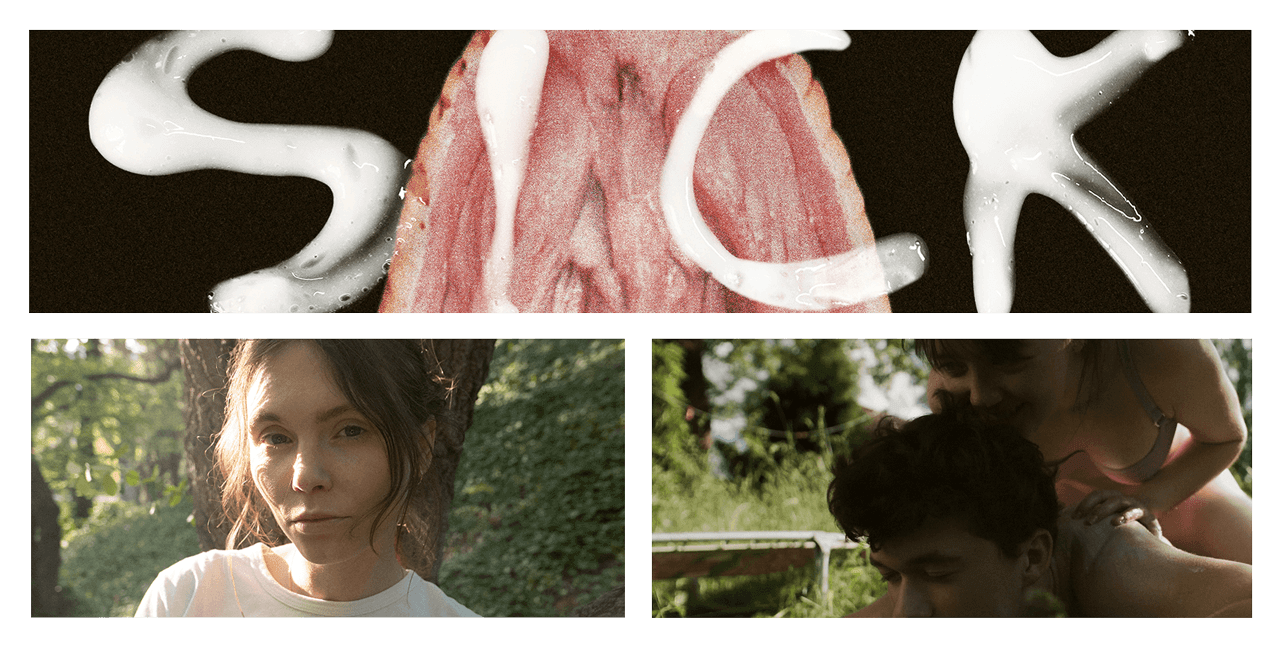
Once acclaimed as the young star of the Oscar-winning Polish drama Ida, Agata Trzebuchowska has shifted from acting to directing with the twisted coming-of-age tale Sick. Recently, Sick won Best Director for Agata Trzebuchowska and received a Best Performance special mention for its leads in the Next Wave section at Fantastic Fest 2026. In a conversation with Borrowing Tape, the filmmaker touches upon how her film explores taboo relationships, filming erotic elements with sensitivity, and why she doesn’t want to be seen as just an actress.
Listen here. The following transcript has been edited and condensed for clarity:
Hello, everyone. I'm Shaurya Thapa of Borrowing Tape, and today I'm joined by Director Agata Trzebuchowska. Those of you who are fans of European and global cinema might remember Agata as the talented young lead of Paweł Pawlikowski's cult-favorite Polish film, Ida. Now, some years have passed since Ida, and Agata is in the director's chair with the new Polish drama film, Sick.
So, Agata, welcome to the podcast, and congratulations on the release of a truly sick film, and I mean that as a compliment.
Thank you.
The film is coming out at Fantastic Fest, and then it's gonna be out in cinemas. How does it feel to put your film out there for the public?
It feels amazing. I had been waiting for this moment for quite a long time, so I'm very happy and grateful that our film's gonna have its first screening and release at Fantastic Fest, and I'm very excited to present the film to the audience.
To me personally, Sick felt like a film that I believe does not fall into a single genre or style very easily. From the looks of it, I initially thought, "Oh, is it, is it a horror?" But then, there are these very complicated sibling dynamics between the protagonists. I'm like, "Oh, this also feels like a family drama. It also feels like I can't really classify this film. How would you introduce the film and characters to anyone who has no idea about Sick?
First of all, I don't need these categories myself. When I create the world and create the characters, I just try to follow them and follow the story and see where it's going and how it's gonna evolve. But the film is perceived as a horror, basically, and a horror of growing up. I would probably introduce it that way, that it's a film about the horror of growing up.
As I mentioned earlier, there are some uncomfortable dynamics between the characters, be it between the siblings themselves or between the siblings and the sick grandmother that they're taking care of. That's a testament to your filmmaking that it can sometimes get disturbing without an in-your-face kind of horror. It's very muted. It felt like the kind of film that lingers in your mind even when the credits roll. I was like, "Okay, I need to think about what I just watched."
Was it always your intention to kind of push the limits of the narrative and deliberately not make it a sort of conventional family drama?
Yes. Definitely. Because I'm touching on a sensitive subject, such as an incestuous relationship or a relationship that is loaded in a way, I was aware that it can be difficult for the viewers to get closer to it; that's why I chose horror as a certain framework to make the story more digestible. There is something very interesting in horror as a genre because it allows you to sit with this discomfort, and it also lets you speak more freely about certain stuff than other conventional genres like drama. You can speak more freely. That's why I was drawn to horror as a certain framework for the story.
As you mentioned the incestual themes in your film, I feel there are many erotic elements that drive the story, but at the same time it does not... The erotic nature of it does not feel cheap or pornographic. Working with the actors, how did you manage to achieve that balance where the nudity or the sex can feel a bit uncomfortable, but also natural without any shock value?
I wasn't looking for shock value, first of all. I wanted the film to feel unsettling, yes, but in a very integrated way, integrated into the characters. And the main question for me was how far you can drift from yourself when you're going through the transformation and when you are becoming something stranger to yourself, and that's what happens to the main character. They are both in very isolated circumstances without any point of reference in terms of what's normal. I really wanted this relationship to feel integrated, and I wasn't looking for this shock value. So I'm glad that it doesn't feel pornographic, or like you said.
Were there any horror or non-horror films or any literature that inspired your writing and directing process for this film?
Not writing in a direct sense, but I read the book called The Cement Garden some time before coming up with the idea, and I think it definitely left a mark on me. Consciously, I try to avoid films and books that are touching on similar subjects as mine, because I want to make sure that I follow my own instincts, rather than compare myself to other directors or writers and second-guess myself. I try not to get influenced by anything specifically.
Most of Sick takes place in the protagonist's grandmother's house.
Yeah.
So, in a way it's kind of like a single-location film, but where was this house located, and how was the filming experience like over there for you? Like the forest, the interiors of the house. How'd it go for you?
We were a very small production, so certain scouting decisions were made because of the limited resources that we had. We had our base, the place that we were supposed to stay in during the film process, in a Masurian village. We were looking for something nearby, and that's how we came across this particular location. It was a very old, pretty run-down house. I want the story to feel intimate and simple in a way so we could focus on the characters and their dynamics. I wanted to place everything, or most of the scenes, in one location. The location had to be very powerful, and I believe that we found a house that feels like a separate character. We wanted to make it a bit dark and to play with this, like, contrast between this beautiful hot summer and the beautiful exteriors, and this very gloomy, isolated, dark house and its interiors.
Lastly, Agata, I wanted to ask you because obviously you've had a career as an actor with Ida. Recently you were in the Charlie XCX film, Erupcja. But now you're also a director, so how do you balance the two art forms? Does your acting ever guide your directing, or would your directing guide your acting? How do they go hand in hand?
I've never seen myself as an actress. Of course, I played in Ida, and it was a very extraordinary experience for me as an actress, but also as a filmmaker because I could have witnessed Paweł Pawlikowski working, and it was very influential and beneficial for me as a director as well. But I've never wanted to continue acting. It's actually interesting because I think that, because I really want to introduce myself to the world in a different role as a director, I also put extra pressure on myself when directing this film. And of course this pressure would be there regardless, but because I really want to say, "Hey, I'm not an actress, I'm a director, and here is my film," this pressure is probably even, even bigger.
Fair enough. Otherwise, you feel that the world would just shoebox you as an actor/director, not just a director, as you want to be now.
Yeah.
So we can expect you to be hopefully making more films in the future as a director, then?
Yes, I hope I will. Yeah.
All right. Fingers crossed. Congratulations again, Agata, on the release.
Thank you so much.
Transcribing film interviews or festival Q&As? Save hours of editing with Notta—automated, highly accurate audio-to-text transcription built for journalists and researchers.