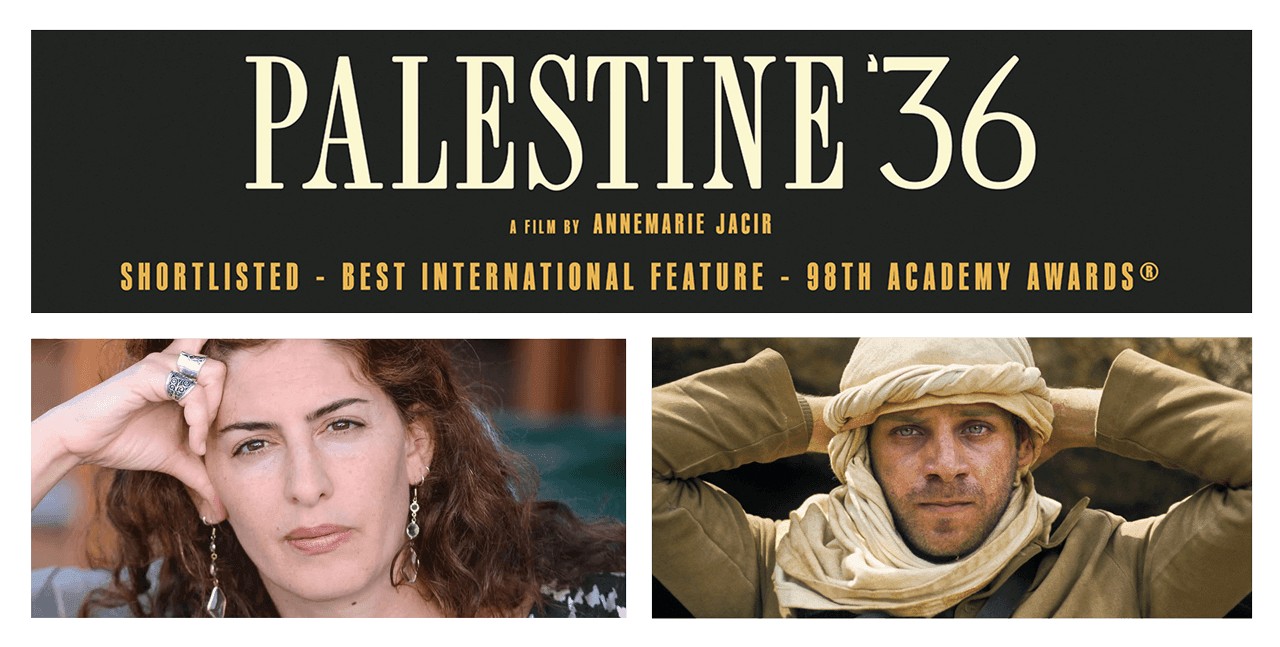
Palestinian writer and filmmaker Annemarie Jacir has been helming stories of the people of her homeland and its diaspora for decades. But with the historical epic Palestine 36, Jacir offers a glimpse into the past as the land was being divided by the British colonial overlords, paving the way for future occupation. Her most ambitious project to date, Palestine 36, plays across multiple narratives to cover the Arab revolts against British occupation from 1936 to 1939. In this interview, Jacir talks to Borrowing Tape about the challenges of recreating 1930s-era Palestine, tackling Israeli censorship around her film, and working with a stacked Palestinian and British cast.
Listen here. The following transcript has been edited and condensed for clarity:
Hello everyone, I am Shaurya Thapa of Borrowing Tape, and today I'm joined with acclaimed Palestinian director and writer Annemarie Jacir. Today, we are talking about her new film, Palestine 36, which is a historical drama on the Arab revolts in 1936 against British colonial rule in Palestine. The film came out last year here in the UK and other parts of the world. It's releasing in the US now and was Palestine's official submission to the Oscars.
Congratulations for the film being out, and welcome to the podcast, Annemarie.
Thank you very much. It's a pleasure to be here.
Before I ask my first question, I just wanted to tell our listeners that this is an ambitious film in the sense that it has a very wide scope. We see not just the locals of Palestine revolting against a colonial system. We also see the talk between the said colonizers, how the British divide this land. We see how all of this eventually also precedes the Nakba — the displacement of Palestinians from their homeland.
So my question to you is, what inspired you to take on such multiple narratives, and what inspired you to focus on this particular era of Palestinian history?
The last part of your question first — it's such an important era, and I think one that is not explored enough, and that's why I was interested in exploring it more deeply. It's an incredible moment, as you said, this mass uprising against British colonial rule, and one that also didn't happen in a vacuum. The British were already in Palestine for almost 20 years at the start of the film, 1936, and there were anti-colonial movements happening in other parts of the Arab world, against the French, Syrians, and they're all sort of connected.
But it's really an incredible moment and a very modern moment where somebody like Yusuf can leave his village and move to the city and the world is changing. And even in the port scenes, with a character like Khalid, many young men — because suddenly there was an industry at the ports and there was work — people were leaving their villages for the first time and becoming part of other things. And there was a big part of that life at the port where men were working to support their families, and it's all in the lead-up before World War II.
And I wanted to explore it through many different characters and not just one character. I didn't want to do it in the sort of classic way of one character who takes us through the whole thing, because I think it's such a layered moment. I think there's so much happening, and the very fact that it's a people's revolt — it was a farmer-led people's revolt — it made sense to me to have the different threads of many different characters who all make up, in their own ways, part of this revolt, whether it's in a very small way or it's in a more direct way. That was something that I wanted to do — not to have the one hero. There is not that one hero; there is a group of people who sort of tell the story of this moment.
I feel how you explain there's so much diversity in the characters and their viewpoints. But I also see that diversity in the literal sense, in the geographical sense, because we see the green olive groves of Palestine, more of the rural hinterland, but then we also see the ports. We see the changing cities.
So, how challenging was it to recreate this Palestine of the 1930s? And also, more importantly, where did you recreate this Palestine, considering the present situation?
It was the biggest challenge of my life to recreate this Palestine of the '30s, because as you said, there's the ports, there's the village, there's the city, and there's many different people, and there's many different classes that are all coming up against this moment, and in some cases against each other.
The original plan for the film was to shoot it entirely in Palestine. The main location of the village was — we found a village in the West Bank, in the Northwest Bank near Salfit, where we started to work and restore the village, plant the crops, and rebuild this village in the way of the 1930s. And for me, the port sequences in Jaffa, I really insisted that we film those in Jaffa. And Jaffa has changed a lot. Of course, it's been ethnically cleansed of its Palestinian population pretty much, and the port has changed a lot. It's sort of become a luxury apartment tourist spot now. So the preparation work for Jaffa involved a lot of discussions with the VFX team, figuring out within our budget how we could film in this city, how to cheat it and how to do it in a way that it would actually be Jaffa, but we would have to erase the skyline of the Tel Aviv skyscrapers and this and that.
And then Jerusalem was Jerusalem — I always planned to shoot in Jerusalem, and we were gonna find our way despite military occupation. We would find our way to film in Jerusalem. And we had a lot of other scenes that were supposed to take place in Bethlehem, like the Atif house, the couple from Jerusalem. We had a beautiful home in Bethlehem which we set up for that.
So of course, after October 7th, we lost all of those locations, and we were not able to film in almost any of them, but particularly the village. So we ended up filming the village scenes in Jordan, as well as some other scenes, and eventually coming back to Palestine to finish the film. And we shot in Jaffa and in Jerusalem and in Bethlehem.
I believe a film like this, which was set in such a monumental era in 1936 and through events preceding the Second World War — what kind of historical or archival research went behind this film? Because you also wrote the screenplay. I can imagine you have to respect all sides, with so many players in your script. What kind of research went into preserving the memories of these characters?
A lot, a lot of research in different ways. There was the personal research, which begins with my own parents and relatives, and this period that I've heard a lot about — the stories of people that I know, their parents or their grandparents who lived this period, a lot of oral histories, a lot of talking about what happened and from their point of view.
Then there was the academic research — I'm so lucky, God bless academics, because there's just been an incredible amount of work done on the period in every aspect: in terms of cultural life, social life, and economic. There's tons of stuff written just about the ports, for example, the whole situation at the ports. There's stuff about the villages by Palestinian and Arab academics, by British academics, by war historians, and by Israeli historians as well. I just read everything I could really get my hands on, and that was a big part of it.
Then there was the archival research, which you mentioned, which really opened up a lot of things for me in terms of visualizing, because Palestine is destroyed. Most of these cities and places that you see in the archives just simply don't exist anymore. That was very important to look at in so many ways — just what life looked like, what people looked like, what people wore, what people did. It tells you a lot about how the British looked at us from up here, looking down, in the way that these archives are images of our homeland and our ancestors, but shot from this British newsreel point of view. And the things that are said, the arrogance of control — you can very much see it. They were putting out these newsreels and sending them all over the world from all their colonies to explain all the great things they were doing. They're fascinating to look at for that.
Then of course all the crew members that I work with: my production designer, my costume designer — there's all the research and work and discussions we do together, and then there's the stuff that they do on their own. The costume designer can talk about costumes forever: the different villages, what people were wearing. Some villages, women were wearing pants underneath the skirt. Some villages they didn't do that. He could tell you everything about it. Everybody had their own research as well.
That makes so much sense, because I feel even in the various media landscape, at least within Western media, there is a certain image of Palestine that is sold — even just in terms of portraying them as victims. But in your film, we see the locals exercising some kind of assertion of their rights. There's a boss who's in the film — you can see her trying to rebel against the British people stealing her homeland. And of course we have the Arab rebels on horseback fighting guns. That seems like a very empowered image for Palestinian cinema on a global scale.
So even when it comes to the battles — and I'm not just talking about the battles fought on horses or with guns — there are moments when I see children and locals just picking up stones and sticks, whatever they can. So how important was it for you to stage that action, but at the same time not make it too overdramatic, to keep it grounded in reality, but also to make these characters empowered?
It's an interesting question, and actually a position that you outlined. Because for me, we have had the short end of the stick politically, but I don't have that attitude for us. And what I think in all my films — and not just this one — is that I'm really amazed by and admire and want to talk about our resistance, human resistance, resisting oppression in whatever form it is. I think that's something to celebrate and actually to be proud of.
Are we perfect? Are we angels? No, we made a lot of mistakes. We make a lot of mistakes. I try to talk about that in the films — and that's in Palestine 36 as well. You see those sorts of mistakes that were made. But in general, I think I'm very much rooted in the belief that there is something very beautiful in telling the story from our point of view. Yes, we did have the longest strike in history at that moment. Yes, we were organized. Yes, our farmers led a revolt that the British couldn't control. With all their military might, they could not control it. There's a lot to be proud of. And that doesn't mean that you're not also critical about certain things.
But I think what we are is we're so used to getting the mainstream media's distorted vision of us and the distorted story of our people. I'm not interested in reacting to that. I don't care. They've done that with every community. Hollywood has done that with every single community since the beginning of time — whether it's Asian, whether it's Black — they just go through whoever politically, depending on what American foreign policy is at that moment. But I'm not interested in that conversation. I think we really have to do things for us, and from us.
As you just mentioned, Hollywood and the West — I feel like every community, even if they get represented, there might be some tokenistic representation as per the West's convenience. And now we're at a time when Palestinian cinema has existed for decades, but it seems there's more global recognition at awards and film festivals. There's your film. There's All That's Left of You by Cherien Dabis, The Voice of Hind Rajab. No Other Land won an Oscar last year.
While you see all of that global recognition for Palestinian storytellers like you, there might also be times when you see that these awards, these critics, are celebrating Palestinian cinema but not actually engaging with the politics or the realities that these films portray. So as a filmmaker and as a Palestinian yourself, how does that make you feel? Does it ever frustrate you?
Look, I want to say I'm above all this, I don't care about these sort of accolades and these things. But what they are good for is that it helps get the films to an audience that might not always be able to get to it. That's the only benefit to me of all of these — whether it's the Oscars or whether it's Cannes or whatever — it's that the film maybe will be given more of a life, because we're all struggling with distribution, we're all struggling to find our audience.
And I think there is a lot to celebrate, as you said, about Palestinian cinema and Palestinian stories. But I think it would be naive to think that anything has really changed. I don't think anything has really changed in that way. There were no Palestinian films in Cannes this year. And all these films you just mentioned — none of them were there. Yes, we noticed when we get something good, but we're really still left out of the picture, and it's really still a struggle — these films don't have mainstream distribution, and people are still afraid to touch these stories. I think we have to keep our finger on that.
Talking about distribution — while Palestine 36 has been backed by companies like BBC Film, BFI, and Watermelon Pictures, which is the leading producer for many Palestinian films — still, how difficult was it to get funding or the right distribution for a project like yours? Because as much as I know, it's being banned or censored in Israel as well. So what were the challenges with just getting this film out?
It was challenging. It took about seven years to finance this film. Now granted, this was a big film — it's bigger than my other films — but all my films take this long. It's always very hard to find partners, to find funding, and many people will flat-out say, "We're not interested in Palestine. We're not interested in the story. We're not interested in the politics." I don't think things have gotten easier. Maybe we find different ways to finance things. I've never had any kind of mainstream funding.
Now, the BBC and BFI getting on board was something, but it's because the executives behind BBC and BFI who supported Palestine 36 specifically were very much aware that this is the British story as well. It's not just a Palestinian story. It's the British story — the British who were everywhere and colonized so many places, and that they still don't talk about and still don't teach in their education system. In our early meetings, they were very supportive. They said it's about time that Brits face their colonial past. And none of them had any kind of creative conditions on me — the film is very tough on the British, and there was not a moment of anyone suggesting maybe you should make it lighter for the audience or a bit easier. So in that way I feel very lucky for that.
I also had a lot of women. At one point I had a Zoom call with all my executive producers, and it was like all women — there were like nine women on the screen. All women of color, by the way. And I thought: in my life, I could never have imagined that 10, 15 years ago. So yes, sometimes I feel like good things are happening, but I think we're still so far away.
What I also found noteworthy about your film is that it has such a stacked cast. You have great British actors, but you have great Palestinian actors — like Hiam Abbass, who we love, like global audiences also love from Ramy and Succession. You have Saleh Bakri, who I absolutely admired in All That's Left of You. Then you also have really good British actors like Jeremy Irons, Robert Aramayo from I Swear, and Liam Cunningham, who joined the flotilla himself.
So what's the experience been like to work with such a diverse and talented cast?
I'm so blessed. I feel so lucky to have had that great cast with me — whether it was first-time actors, a lot of them, new faces acting for the first time. Saleh Bakri, as you mentioned, is my long-time partner. We began our first film together and we still work together.
And then to have somebody like Jeremy Irons or Liam Cunningham on set — and also their participation was very much one of solidarity. They participated in the film because they believed in the film and they wanted to support it. And Jeremy was very upfront about that. He said, "I don't know if it's helpful for you, but if it is, I'd like to be in the film." He proposed it. And of course it's helpful when you're trying to finance a film and you have an A-lister like Jeremy Irons willing to participate. It was really special.
And Liam — it was a no-brainer for Liam. He's so politically engaged, and he's Irish. He was great because he always keeps reminding us: "You guys have been under occupation for this long, but we had it for 700 years. So, patience."
I could tell you stories about each one of them. I feel really lucky that I had that great cast — and also that I didn't lose them. When we had to change locations, everything was falling apart and we had to stop and start so many times, and then I got to continue with the same cast. That was really amazing.
Palestine 36 can be heavily emotional and dark in parts, and the way it shows displacement. But I feel like towards the end especially, there's always an underlying hope and resilience in the story. Seeing families and people still holding on, with slogans, with their weapons, their resistance as you mentioned earlier — how important was it for you to make this film a story of hope as well, especially in the current times?
Yeah, because it is devastating — there are very devastating moments in the film. But I didn't want to end it there, because I think that's also part of paying homage to the story of resilience: that we do continue, Palestinians continue, generation after generation. It's the next generation, it's the now generation that we don't yet know. In a way it's an open-ended ending — where she's going, what she's doing. But for me, absolutely, there's something very beautiful and hopeful in that moment.
We're watching the story of 1936 today. The audience is in the room watching it today. We know that in 10 years is the Nakba for these characters — all of them will basically become refugees, including Khouloud and Amir, and that house that they're living in, that neighborhood they're living in, is ethnically cleansed in 10 years. We know that. We come with that as an audience — more or less. Some people of course don't, they come with more of a clean slate. But most of us, I think, know that. And I think the thing to celebrate is that we keep going, and we have to believe and we have to fight for that hope.
That's a really hopeful note to end this interview with, and I hope this film gets more recognition and reaches more people. It was lovely talking to you, Annemarie.
Thank you.
Congratulations once again.
Thank you very much. Lovely talking to you.