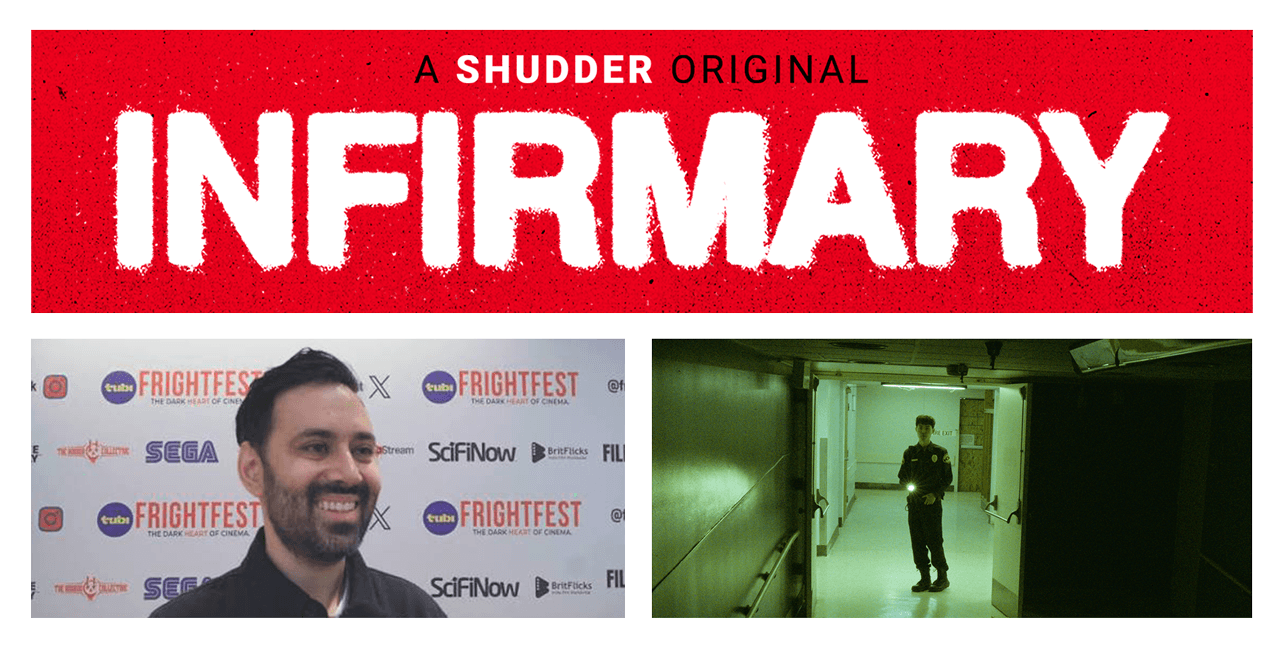
A psych ward night shift turns into a claustrophobic nightmare in director Nicholas Pineda's debut feature Infirmary. In this interview with Borrowing Tape, Pineda breaks down filming his found-footage horror in an abandoned hospital, using bodycam footage, and why he believes it's a good time for independent horror filmmaking.
Listen here. The following transcript has been edited and condensed for clarity:
Hello, everyone. I am Shaurya Thapa of Borrowing Tape, and today I'm joined by director Nicholas Pineda, the man behind the new found-footage survival horror Infirmary. This film is set over one chaotic night in a psych ward hospital. Our hero is a security guard, and it's his first night on the job, and well, it's not the smoothest night shift, let's put it like that. Welcome to the podcast, Nicholas. How are you doing? How does it feel for this film to be screened at horror-specific film festivals? I remember this premiered at Fright Fest in the UK last week.
Yeah, it's been an amazing experience so far. It's my first feature film and first time doing the festival circuit. It's just been a great new experience for me, and learning a lot. It's just been amazing meeting all these new people and seeing the audience reactions. It's been a great time.
To put it crudely, it's a found footage kind of film, and the found footage genre obviously is not new. We have had Blair Witch Project, Paranormal Activity, and the bazillion offshoots and rip-offs and clones. Of course, we have exceptions like the Spanish film Rec.
Oh, I love Rec.
Personally, if you ask me, Infirmary and Rec make for a perfect double bill.
Oh, yeah. They would be a great pair together.
Given that this is your feature directorial debut, it can still be a monotonous, overdone genre to take on. While stepping into a project like Infirmary, did you have doubts or fears that made you feel that, "Oh, I'm entering very familiar territory. What if my film comes across as clichéd to horror audiences?"
Yeah, that was a big fear. But that was the inspiration or start of the idea: watching real police body cam footage videos on YouTube during the pandemic. Then at that time, there hadn't been any found footage films made with body cams. So I was like, "Oh, this would be a great new perspective or way to utilize the found footage format: through the lens of a body cam," because it avoids a lot of the pitfalls that certain found footage films run into, where it's hard to justify why a character would be recording themselves, or it's always from the perspective of a documentarian or mockumentarian. At that time, it was a fresh new take on the genre. I also wanted to add in a few cinematic levels with the sound design and the score, the way we approached the score, and then the way we did the cinematography and lighting. A lot of those elements were ways of hoping to try to do at least a new take, to not be too clichéd within the found footage format. So yeah, there was definitely a lot of consideration.
But also at the time, I put myself on an embargo during the whole production process of watching any found footage films, because I just didn't wanna get too referential to other found footage films. Or if I even did see something that they did that would be similar to my film, I didn't want it to corrupt too much of the filmmaking process. I put an embargo on found footage for the past couple of years, but I'm sure there were a lot of similarities, like you said, with Rec. You just can't help it because it just oozes out of my…Because I've watched so many found footage films and horror films, you know? Some of that stuff just naturally just bled out of me.
Talking about references — personally, I found Infirmary to be quite original and subversive in an oversaturated genre, as I said. But obviously, because your film is set in such claustrophobic, cramped confines of a psych ward. Obviously, in parts it reminded me of Backrooms, which of course came out this year, and it made liminal spaces more mainstream. We've also had films, recent horror films, like Iron Lung, which was set entirely inside a submarine. Do you think it's a great time for claustrophobic, closed-space horror right now, especially this year, with a film like yours as well?
Yeah. I just think it's a great time for independent film, horror films, and a lot of that comes from just the kind of limitations that filmmakers are having, because I was trying to follow the format of Jason Blum. He has this trilemma that he talks about for making independent horror films. You can only choose two of three options: you could either have the big cast, you could have a lot of locations, or you could have a lot of practical effects. Those are his three main things you could choose for an independent film. Unfortunately for me, I could only choose one of them, which was one big location, which was the hospital. Which I think is what a lot of indie filmmakers are probably going through right now, where it's like they got to choose from those options. Having a story contained within one location is a good way to work within a limited budget. But people are becoming very creative and doing awesome things, and I think even the found footage genre's seen a lot of really great, exciting, experimental stuff coming out of it right now.
You mentioned the location, and this is my next question. Where was this hospital, or was it an actual hospital?
Yeah, it was a real abandoned hospital that we found in LA. It took us like a year to convince them to let us shoot there. The whole movie was shot in there, so every location, every scene. We didn't cheat by shooting anything in a studio or some off-site location. It was all contained in that hospital, and it was as disgusting and frightening as it looks in the film.
Was it ever eerie or haunting filming at a place like that?
Oh, yeah, it was super eerie. We actually did have a couple of break-ins while we were shooting it, so just like what happened in the movie really happened to us.
And then there were even parts of the hospital that the guards would tell us, "Do not go down there. Do not go down this area." Not because it's hazardous or forbidden, just because it's a deeply haunted area within the basement that we were told to avoid at all costs. So me and all the other cast and crew, we avoided that area. It was truly frightening. It was pitch black. No lights worked in there, and you just felt this aura, this mass amount of dark energy from that one specific spot in the hospital. So we avoided that at all costs.
I know that the screenplay of Infirmary is written by Katy Krauland, but you're credited with the story as well. Tell me about the story. What inspired you to come up with this psych ward night shift premise?
It was mainly constructed around just a couple of building blocks. So it was like body cam. It needed to be one location just for budget and a very limited cast. Who would those be, these people with the body cameras? Oh, it'd be these security guards. One would for sure have to be a rookie, so he's the young, inexperienced guy, and then one of them would have to be the older, overbearing supervisor. Then we needed a third person. Who else would be at this location? It would be this office administrator. We were kind of just finding all these building blocks because originally it was supposed to take place in an abandoned office space, but once we found this hospital, we had to recraft the story or a lot of the elements around it. Just a bunch of stuff like that. Then we just wanted to find out more about who these characters are, and what their dynamics would be. It was really just a lot of that. We got a lot of story elements from the actual guards at the hospital, too. As we were getting tours of the hospital, going around, the guards would be telling us all these stories, and we're like, "Oh, that's great." So we're just writing everything down as inspiration. It was a bunch of different elements and then just working together to craft the film.
Lastly, my final question to you, Nicholas, is: what was your biggest takeaway, or what were the challenges for you making your debut feature film, which is entirely shot on body cam footage and filmed on a tight schedule with just one location, three actors? What were the challenges for you, takeaways?
It's tough. I mean, it's like a million things I learned because just going through all this for pretty much the first time has just been such a wealth of new information. The biggest takeaway as a practical filmmaker — which I learned from doing this and then I've since watched some documentaries about, even the making of Paranormal Activity — is to give yourself time to edit the film. Shoot it, edit it, but then really allow yourself and give yourself time to do pickups or do new scenes if it's necessary, because I think that's just such a valuable part. Don't be limited to your first preconceived notion of what you got from the first time shooting and then forcing yourself to only edit with that material. A lot of filmmakers, I feel, are limited to: we got it once, we have to make it work, and use their preconceived notions. Allow the film to organically develop even during the post-production process.
Perfect. Thank you. Thank you for your time, Nicholas.
Yeah, thank you.
Congratulations again on the release of Infirmary, which I would describe as a really freaky workplace horror. Something that I would dream of when I'm napping in my office on a night shift. It really spoke to me. So thank you.
[Laughs] That's awesome.
Watch Infirmary
Not available in your country? Access worldwide streaming catalogs securely with NordVPN.
Transcribing film interviews or festival Q&As? Save hours of editing with Notta—automated, highly accurate audio-to-text transcription built for journalists and researchers.